Ambiente: milieu / zona climática / intervalo de profundidade / gama de distribuição
Ecologia
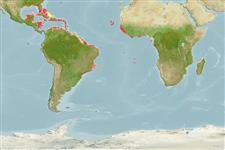
marinhas associadas(os) a recifes; não migratória (Ref. 55747); intervalo de profundidade 0 - 10 m (Ref. 27000), usually 0 - 5 m (Ref. 40849). Tropical; 34°N - 34°S, 100°W - 11°E
Western Atlantic: Bermuda, Florida (USA), Bahamas, and northern Gulf of Mexico to Rio de Janeiro, Brazil (Ref. 13628). Eastern Atlantic: Madeira (Ref. 13612), Canary Islands, and the coast of West Africa south to equatorial Guinea (Ref. 7404).
Tamanho / Peso / Idade
Maturidade: Lm ? range ? - ? cm
Max length : 23.0 cm TL macho/indeterminado; (Ref. 7251)
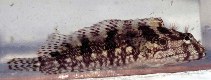
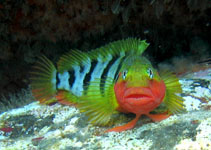
Espinhos dorsais (total) : 18 - 19; Raios dorsais moles (total) : 11 - 13; Espinhos anais: 2; Raios anais moles: 18 - 19; Vértebras: 11 - 13. Diagonal transverse row of cirri on a fleshy base on upper posterior part of each side of head; with 4 irregular dark brown bars; pale edged black spot on opercle; often a dark spot at front of dorsal fin; adult males with red on lower part of head, chest and abdomen (Ref. 13442). Robust, with a sharply pointed or sub obtuse head. Anterior nare is tubular and with an apical lid that prevents the penetration of sand particles (Ref. 94108).
Body shape (shape guide): fusiform / normal.
Diurnal, bottom-dwelling species which occur in rocky and rubble shores with algal mats, reefs and seagrass beds. Generally at depths of a few cm (Ref. 13628). Usually seen resting in holes or crevices, and when disturbed quickly move to another crevice. This species is the largest of the labrisomids in the Caribbean region (Ref. 26938). Feed mainly on crustaceans and gastropods (Ref. 13628), brittle stars, sea urchins, fishes and polychaete worms (Ref. 13442). Oviparous, spawn in territories and exhibit paternal care of eggs (Ref. 55747). Larvae are pelagic which eventually settle down at the bottom as juveniles (Ref. 42064).
Exhibits paternal care. Mating begins with three stages of courtship: 1) attraction and identification of prospective mate; 2) arousal and appeasement by nudging (the female initiates this move); 3) synchrony occurs when the female starts to rub the rocky wall in the spawning territory, quivering her body against the rock, shaking her anal fin and keeping her dorsal fin erect, the male meanwhile remained perpendicular, biting the sides of the female's body, dorsal fin and upper side of head, and sometimes rubbing her body laterally with his tail. Release of eggs and sperm follows as the male and female bodies quiver. Nest fanning by the male parent comes after this range of display. Driven out by the male, the female moves away from the spawning area while the male continues to patrol the nest, swimming in circular direction and defending the area against other fish. Each cycle lasts for 65.3 seconds, becoming shorter in duration when there are two females involved in the mating event. One cycle is followed by another after the male has returned from patrolling the nest (Ref. 55747).
Robins, C.R. and G.C. Ray, 1986. A field guide to Atlantic coast fishes of North America. Houghton Mifflin Company, Boston, U.S.A. 354 p. (Ref. 7251)
Categoria na Lista Vermelha da IUCN (Ref. 130435: Version 2025-2 (Global))
Ameaça para o homem
Harmless
Utilização humana
Pescarias: espécies comerciais; Aquário: Espécies comerciais
Ferramentas
Relatórios especiais
Descarregue XML
Fontes da internet
Estimativas baseadas em modelos
Temperatura preferida (Ref.
123201): 23.6 - 28.1, mean 27.4 °C (based on 940 cells).
Índice de diversidade filogenética (Ref.
82804): PD
50 = 0.5005 [Uniqueness, from 0.5 = low to 2.0 = high].
Bayesian length-weight: a=0.00912 (0.00459 - 0.01811), b=3.12 (2.95 - 3.29), in cm total length, based on LWR estimates for this species & (Sub)family-body (Ref.
93245).
Nível Trófico (Ref.
69278): 3.6 ±0.2 se; based on diet studies.
Resiliência (Ref.
120179): Médio, tempo mínimo de duplicação da população 1,4 - 4,4 anos (Fec = 5,000).
Vulnerabilidade da pesca (Ref.
59153): Low vulnerability (13 of 100).
🛈
Nutrientes (Ref.
124155): Calcium = 74.8 [46.2, 116.0] mg/100g; Iron = 0.701 [0.438, 1.126] mg/100g; Protein = 19.1 [18.1, 20.1] %; Omega3 = 0.128 [0.085, 0.193] g/100g; Selenium = 23.6 [13.4, 41.0] μg/100g; VitaminA = 95.9 [35.7, 258.2] μg/100g; Zinc = 1.59 [1.14, 2.15] mg/100g (wet weight);