Klassifizierung / Names
Namen | Synonyme | Catalog of Fishes(Gattung, Arten) | ITIS | CoL | WoRMS | Cloffa
Umwelt: Milieu / Klimazone / Tiefenbereich / Verbreitungsgebiet
Ökologie
seewasser demersal. Tropical
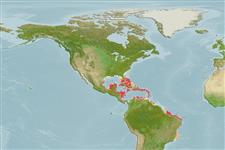
Western Atlantic: southern Florida (USA), Bahamas, and northeastern Gulf of Mexico to Greater Antilles and Central America (Ref. 7251). Also western Caribbean, Antilles, Yucatan (Mexico) (Ref. 26938).
Größe / Gewicht / Alter
Geschlechtsreife: Lm ? range ? - ? cm
Max length : 7.5 cm TL Männchen/unbestimmt; (Ref. 7251)
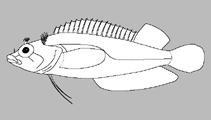
Rückenflossenweichstrahlen (insgesamt) : 7 - 37; Afterflossenstacheln: 2. Common amongst Labrisomids: small, often elongate fishes; largest species about 20 cm standard length, most under 10 cm standard length. Head usually with cirri or fleshy flaps on anterior nostrils, eyes, and laterally on nape; gill membranes continuous with each other across posteroventral surface of head. Each jaw with an outer row of relatively large, canine-like or incisor-like teeth, often with patches of smaller teeth behind; teeth usually also present on vomer and often on palatines (roof of mouth). Dorsal and anal fins long, frequently highest anteriorly; dorsal-fin spines often flexible, outnumbering segmented dorsal-fin soft rays; 2 usually flexible spines in anal fin; pelvic fins inserted anterior to pectoral-fin bases, with 1 spine not visible externally; all fin rays, including those of caudal, unbranched (simple). Cycloid (smooth to touch) scales present at least posteriorly on body. Body coloration: varying from drab to brilliant hues; usually with irregular vertical bands, spots, or marbled pattern. Species distinguished by: length of shortest pelvic-fin ray half, or less than half, length of longest ray; pectoral-fin rays usually 14; maxillary bone exposed posteriorly; patches of small teeth behind outer row of large teeth in at least upper jaw; palatine teeth present, some distinctly larger than those on vomer and some equal in size; two or more cirri on each side of nape just anterior to dorsal-fin origin; pelvic-fin soft rays 3 (innermost ray may be reduced in length and folded over middle ray); scales in lateral-line series 40 to 69 (some scales in posterior portion of lateral line may lack sensory tubes, but are included in count); lateral-line tubes or canals present at least anteriorly on body; dorsal fin consisting of spines and 7 to 37 segmented rays (Ref.52855).
Body shape (shape guide): elongated.
Occurs from rocky and rubble shores with algal mats to reefs and seagrass beds.
Lebenszyklus und Paarungsverhalten
Geschlechtsreife | Fortpflanzung | Ablaichen | Eier | Fruchtbarkeit | Larven
Robins, C.R. and G.C. Ray, 1986. A field guide to Atlantic coast fishes of North America. Houghton Mifflin Company, Boston, U.S.A. 354 p. (Ref. 7251)
IUCN Rote Liste Status (Ref. 130435: Version 2025-2 (Global))
Bedrohung für Menschen
Harmless
Nutzung durch Menschen
Fischereien: kommerziell; Aquarium: Kommerziell
Tools
Zusatzinformationen
Download XML
Internet Quellen
Schätzungen auf der Grundlage von Modellen
Bevorzugte Temperatur (Ref.
123201): 26.4 - 28.2, mean 27.5 °C (based on 577 cells).
Phylogenetischer Diversitätsindex (Ref.
82804): PD
50 = 0.5078 [Uniqueness, from 0.5 = low to 2.0 = high].
Bayesian length-weight: a=0.00525 (0.00218 - 0.01265), b=3.08 (2.86 - 3.30), in cm total length, based on LWR estimates for this (Sub)family-body shape (Ref.
93245).
Trophische Ebene (Ref.
69278): 3.7 ±0.6 se; based on size and trophs of closest relatives
Anfälligkeit der Fischerei (Ref.
59153): Low vulnerability (10 of 100).
🛈