>
Ovalentaria/misc (Various families in series Ovalentaria) >
Opistognathidae (Jawfishes)
Etymology: Opistognathus: Greek, opisthe = behind + Greek, gnathos = jaw (Ref. 45335); to the very elongate upper jaw of the type species of the genus, Opistognathus nigromarginatus (Ref. 128653).
More on author: Poey.
Ambiente: milieu / zona climatica / distribuzione batimetrica / gamma di distribuzione
Ecologia
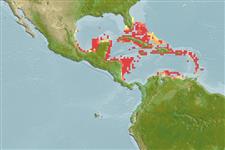
marino associati a barriera corallina; non migratori (Ref. 52884); distribuzione batimetrica 1 - 8 m (Ref. 89891). Tropical; 29°N - 10°N, 98°W - 59°W
Western Atlantic: southern Florida, USA and Bahamas to Central America, West Indies and Caribbean Islands.
Dimensione / Peso / Età
Maturità: Lm ? range ? - ? cm
Max length : 13.0 cm TL maschio/sesso non determinato; (Ref. 7251)
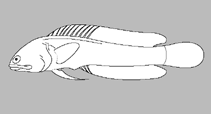
Spine dorsali (totale) : 11; Raggi dorsali molli (totale) : 15; Spine anali: 3; Raggi anali molli: 15. Black spot in the dorsal fin is in the lower half of the fin and is usually located between the 6th and 9th spines; there is some brown pigment at the corner of the mouth but no black and white bands inside the maxilla (Ref. 13442).
Body shape (shape guide): elongated.
Adults inhabit an elaborate burrow, often fairly deep (12 inches), and with a terminal chamber; the vertical shaft lined with coral and shell fragments. Males are oral brooders (Ref. 5521). Monogamous and always in home-ranging pairs, that is they do not defend an exclusive territory (Ref. 52884).
Ciclo vitale e comportamento di accoppiamento
Maturità | Riproduzione | Deposizione | Uova | Fecondità | Larve
Males incubate the eggs in the mouth (Ref. 33037, 39363).
Robins, C.R. and G.C. Ray, 1986. A field guide to Atlantic coast fishes of North America. Houghton Mifflin Company, Boston, U.S.A. 354 p. (Ref. 7251)
Stato della Lista Rossa IUCN (Ref. 130435: Version 2025-2 (Global))
Minaccia per l'uomo
Harmless
Usi umani
Pesca: commerciale; Acquario: Commerciale
Strumenti
Rapporti speciali
Scarica XML
Fonti Internet
Stime basate su modelli
Temperatura preferita (Fonte Biblio.
123201): 26.4 - 28.1, mean 27.4 °C (based on 476 cells).
Indice di diversità filogenetica (Fonte Biblio.
82804): PD
50 = 0.5000 [Uniqueness, from 0.5 = low to 2.0 = high].
Bayesian length-weight: a=0.00389 (0.00180 - 0.00842), b=3.12 (2.94 - 3.30), in cm total length, based on all LWR estimates for this body shape (Ref.
93245).
Livello trofico (Fonte Biblio.
69278): 3.5 ±0.6 se; based on size and trophs of closest relatives
Vulnerabilità della pesca (Ref.
59153): Low vulnerability (10 of 100).
🛈
Nutrienti (Ref.
124155): Calcium = 121 [62, 189] mg/100g; Iron = 0.719 [0.415, 1.204] mg/100g; Protein = 18.4 [17.3, 19.5] %; Omega3 = 0.0847 [, ] g/100g; Selenium = 21.6 [9.7, 45.7] μg/100g; VitaminA = 135 [43, 410] μg/100g; Zinc = 2.01 [1.34, 2.86] mg/100g (wet weight);