>
Carangaria/misc (Various families in series Carangaria) >
Polynemidae (Threadfins)
Etymology: Polydactylus: Greek, poly = a lot of + greek, daktylos = finger (Ref. 45335).
More on authors: Lay & Bennett.
Miljö: miljö / Klimatzon / djupintervall / distributionsområde
Ekologi
marina; brackvatten bottenlevande; djupintervall 10 - 60 m (Ref. 91172). Subtropical; 37°N - 12°S, 122°W - 77°W (Ref. 57343)
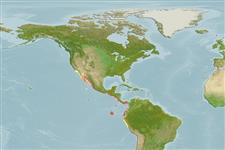
Eastern Pacific: Monterey Bay, California, USA to Callao, Peru. One record from the Galapagos Islands. Rare north of Baja California, Mexico (Ref. 2850). Record from Chile (Ref. 9068) needs to be verified (Ref. 57343).
Storlek / Vikt / Ålder
Könsmognad: Lm ? range ? - ? cm
Max length : 36.8 cm TL hane/ej könsbestämd; (Ref. 115882); common length : 20.0 cm TL hane/ej könsbestämd; (Ref. 55763)
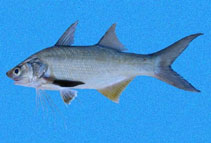
Taggstrålar i ryggfenan (totalt) : 9; Mjukstrålar i ryggfenan (totalt) : 11 - 13; Taggstrålar i analfenan: 3; Mjukstrålar i analfenan: 13 - 15; Ryggkotor: 24. Body grayish, no stripes or spots. Lip on lower jaw well developed. Dentary teeth restricted to dorsal surface. Maxilla not covered with scales. Pectoral filaments 6; longest not reaching beyond level of posterior end of anal fin base. Lateral line bifurcated on caudal fin membranes, extending to posterior margins of upper and lower caudal fin lobes. Swim bladder present (Ref. 45049).
Body shape (shape guide): fusiform / normal; Cross section: compressed.
Found in shallow water near the coast, on sand and mud bottoms (Ref. 9332). Larvae and small juveniles (>4 cm) are pelagic and sometimes occur several hundred kilometers offshore, whereas the larger juveniles and adults prefer shallow near-shore waters like bays, sloughs or estuaries where the bottom is sandy or muddy (Ref. 28023). Omnivorous, feeds on worms, sand crabs, shrimp, clams; sometimes feeds on fish like small anchovy (Ref. 28023). Esteemed food fish where it occurs (Ref. 57343). Also Ref. 55763.
Livscykel och parningsbeteende
Könsmognad | Reproduktion | Lek | Ägg | Fekunditet | Larver
Motomura, H., 2004. Threadfins of the world (Family Polynemidae). An annotated and illustrated catalogue of polynemid species known to date. FAO Spec. Cat. Fish. Purp. Rome: FAO. 3:117 p. (Ref. 57343)
Status på IUCN:s rödlista (Ref. 130435: Version 2025-2 (Global))
Hot mot människor
Harmless
Mänskliga användningsområden
Fiskeri: kommersiell
Verktyg
Särskilda rapporter
Ladda ner XML
Internet-källor
Uppskattningar baserade på modeller
Önskad temperatur (Ref.
123201): 20.5 - 29, mean 25.9 °C (based on 273 cells).
Index för fylogenetisk mångfald (Ref.
82804): PD
50 = 0.5000 [Uniqueness, from 0.5 = low to 2.0 = high].
Bayesian length-weight: a=0.00661 (0.00440 - 0.00993), b=3.06 (2.94 - 3.18), in cm total length, based on LWR estimates for this species & Genus-body shape (Ref.
93245).
Trofisk nivå (Ref.
69278): 3.6 ±0.6 se; based on diet studies.
Resiliens (Ref.
120179): Hög, lägsta populationsfördubblingstid mindre än 15 månader (Preliminary K or Fecundity.).
Sårbarhet i fisket (Ref.
59153): Low to moderate vulnerability (27 of 100).
🛈
Näringsämnen (Ref.
124155): Calcium = 101 [51, 203] mg/100g; Iron = 1.13 [0.58, 2.10] mg/100g; Protein = 20.2 [18.6, 21.8] %; Omega3 = 0.402 [0.275, 0.617] g/100g; Selenium = 24.2 [12.8, 48.0] μg/100g; VitaminA = 9.48 [3.93, 22.61] μg/100g; Zinc = 0.904 [0.619, 1.327] mg/100g (wet weight);