>
Eupercaria/misc (Various families in series Eupercaria) >
Labridae (Wrasses) > Xyrichtyinae
Etymology: Xyrichtys: Greek, xyreo = that cuts like a knife + Greek, ichthys = fish (Ref. 45335).
More on author: Valenciennes.
Milieu: milieu / Klimaatzone / Diepte / verspreidingsgebied
Ecologie
marien rifbewoner; diepte 2 - 21 m (Ref. 7251). Subtropical
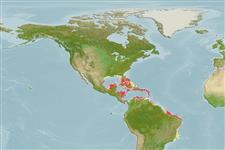
Western Atlantic: southern Florida, USA and Bahamas to northern South America.
Grootte / Gewicht / Leeftijd
Maturiteit: Lm ? range ? - ? cm
Max length : 19.3 cm SL mannelijk / geslacht onbekend; (Ref. 137577)
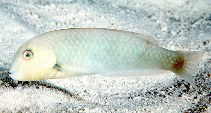
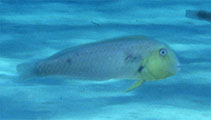
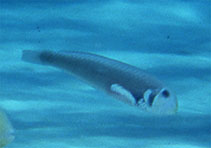
Females light greenish gray, becoming pinkish ventrally, with diffuse orange-red stripe from behind eye to base of caudal fin; a broad white area over abdomen, the lower part with vertical lines of red; there may be faint red bars on the body. Large adult males lose the distinctive red, white and black markings; they develop a vertically elongate blue spot on each body scale; a yellow head with near-vertical pale blue bands, and a large dark spot in axil of pectoral fins (Ref. 13442).
Body shape (shape guide): elongated.
Most common in open sandy areas. Feeds on small sand-dwelling invertebrates. Dives head first into the sand when frightened. Generally common (Ref. 9710). Generally of no interest to fisheries because of its small average size (Ref. 5217).
Levenscyclus en paargedrag
Maturiteit | Voortplanting | Paaien | Eieren | Fecunditeit | Larven
Robins, C.R. and G.C. Ray, 1986. A field guide to Atlantic coast fishes of North America. Houghton Mifflin Company, Boston, U.S.A. 354 p. (Ref. 7251)
Status op de Rode Lijst van het IUCN (Ref. 130435: Version 2025-2 (Global))
Gevaar voor de mens
Harmless
Gebruik door de mens
Visserij: commercieel; Aquarium: Commercieel
Tools
Speciale rapporten
Download XML
Internetbronnen
Schattingen op basis van modellen
Gewenste temperatuur (Ref.
123201): 25.1 - 28.2, mean 27.4 °C (based on 619 cells).
Fylogenetische diversiteitsindex (Ref.
82804): PD
50 = 0.5005 [Uniqueness, from 0.5 = low to 2.0 = high].
Bayesian length-weight: a=0.00661 (0.00272 - 0.01607), b=3.05 (2.84 - 3.26), in cm total length, based on LWR estimates for this (Sub)family-body shape (Ref.
93245).
Trofisch niveau (Ref.
69278): 3.5 ±0.37 se; based on food items.
Weerstandsvermogen (Ref.
120179): Gemiddeld, minimale populatieverdubbelingstijd 1,4-4,4 jaar (Preliminary K or Fecundity.).
Kwetsbaarheid van de visserij (Ref.
59153): Low vulnerability (14 of 100).
🛈
Voedingsstoffen (Ref.
124155): Calcium = 65.3 [27.2, 142.0] mg/100g; Iron = 0.678 [0.355, 1.489] mg/100g; Protein = 18.7 [15.8, 21.0] %; Omega3 = 0.147 [0.074, 0.285] g/100g; Selenium = 11.4 [4.8, 27.1] μg/100g; VitaminA = 85.4 [22.3, 426.5] μg/100g; Zinc = 1.19 [0.69, 2.13] mg/100g (wet weight);