>
Eupercaria/misc (Various families in series Eupercaria) >
Labridae (Wrasses) > Julidinae
Etymology: Halichoeres: Greek, als, alis = salt + Greek, choiros = pig (Ref. 45335).
More on authors: Müller & Troschel.
Entorno: milieu / zona climática / rango de profundidad / gama de distribución
Ecología
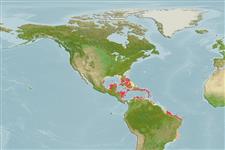
marino asociado a arrecife; rango de profundidad 2 - 24 m (Ref. 9710). Tropical; 36°N - 25°S, 99°W - 32°W
Western Atlantic: North Carolina, USA and Bermuda to Brazil.
Tamaño / Peso / Edad
Madurez: Lm ? range ? - ? cm
Max length : 18.0 cm TL macho / no sexado; (Ref. 7251)
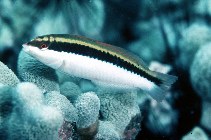
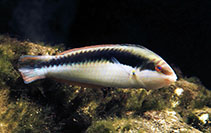
Espinas dorsales (total) : 9; Radios blandos dorsales (total) : 11; Espinas anales: 3; Radios blandos anales: 11. Wide black stripe through eye to base of tail, bordered above by prominent gold line. Large black spot on mid-side. Large black spot on mid-side above origin of anal fin (Ref. 26938). Three transverse red bands on top of head; large adult males become primarily rose and green, lose the dark lateral stripe, gain a prominent black spot on mid-side, and have a larger black spot in the spinous portion of the dorsal fin (Ref. 13442).
Body shape (shape guide): fusiform / normal.
Abundant on reef tops and in shallow rocky areas. Found to depths of at least 25 m (Ref. 26938). Also found in Sargassum beds (Ref. 9626). Solitary and wary and can be difficult to approach (Ref. 26938). The tricolored pattern of the initial phase is similar to that of the juveniles of the yellowmouth grouper, Mycteroperca interstitialis, an aggressive mimic (Ref. 43465). A protogynous hermaphrodite (Ref. 55367). Generally of no interest to fisheries because of its small average size (Ref. 5217).
Ciclo vital y comportamiento de apareamiento
Madurez | Reproducción | Puesta | Huevos | Fecundidad | Larva
Diandric. Forms leks during breeding (Ref. 55367). Length at sex change = 10.9 cm TL (Ref. 55367).
Robins, C.R. and G.C. Ray, 1986. A field guide to Atlantic coast fishes of North America. Houghton Mifflin Company, Boston, U.S.A. 354 p. (Ref. 7251)
Situación en la Lista Roja de la UICN (Ref. 130435: Version 2025-2 (Global))
Amenaza para el ser humano
Harmless
Usos humanos
Pesquerías: comercial; Acuario: Comercial
Herramientas
Informes especiales
Descargar XML
Fuentes de Internet
Estimaciones basadas en modelos
Temperatura preferida (Referencia
123201): 25.5 - 28.2, mean 27.4 °C (based on 685 cells).
Índice de diversidad filogenética (Referencia
82804): PD
50 = 0.5000 [Uniqueness, from 0.5 = low to 2.0 = high].
Bayesian length-weight: a=0.01047 (0.00607 - 0.01808), b=3.21 (3.06 - 3.36), in cm total length, based on LWR estimates for this species & Genus-body shape (Ref.
93245).
Nivel trófico (Referencia
69278): 3.3 ±0.2 se; based on diet studies.
Resiliencia (Referencia
120179): Alto, población duplicada en un tiempo mínimo inferior a 15 meses (Preliminary K or Fecundity.).
Vulnerabilidad pesquera (Ref.
59153): Low vulnerability (10 of 100).
🛈
Nutrientes (Ref.
124155): Calcium = 79.7 [47.7, 130.9] mg/100g; Iron = 0.694 [0.408, 1.271] mg/100g; Protein = 18.5 [15.6, 20.6] %; Omega3 = 0.146 [0.095, 0.225] g/100g; Selenium = 23.2 [14.3, 40.9] μg/100g; VitaminA = 133 [43, 483] μg/100g; Zinc = 1.7 [1.2, 2.7] mg/100g (wet weight);