>
Ovalentaria/misc (Various families in series Ovalentaria) >
Pomacentridae (Damselfishes) > Microspathodontinae
Etymology: Stegastes: Greek, stegastos, -e, -on = covered (Ref. 45335).
More on author: Cuvier.
Περιβάλλον: περιβάλλον / κλιματική ζώνη / εύρος βάθους / εύρος διανομής
Οικολογία
Θαλασσινό(ά) Υφαλόφιλο(α); μη μεταναστευτικό(ά); εύρος βάθους 1 - 30 m (Ref. 7247). Tropical
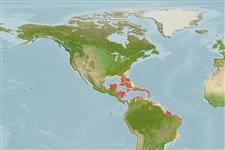
Western Atlantic: including southern Florida (USA), Bahamas, and the Caribbean Sea.
Μέγεθος / Βάρος / Ηλικία
Γεννητική Ωρίμανση: Lm ? range ? - ? cm
Max length : 13.0 cm TL αρσενικό/απροσδιόριστο; (Ref. 26340)
Σύντομη περιγραφή
Κλείδες προσδιορισμού | Μορφολογία | Μορφομετρία
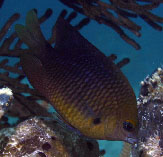
Ραχιαίες άκανθες (συνολικά) : 12; Μαλακές ραχιαίες ακτίνες (συνολικά) : 15 - 17; Εδρικές άκανθες: 2; Μαλακές εδρικές ακτίνες: 13 - 14. Adults brownish gray with a yellowish cast; vertical dark lines following scale rows; a large blackish spot covering most of pectoral base, darkest near upper part; pectorals slightly dusky. The young are bright yellow with a large black spot at base of dorsal fin at junction of spinous and soft portions, a large black spot dorsally on caudal peduncle and a small one at upper pectoral base (Ref. 13442).
Body shape (shape guide): short and / or deep; Cross section: compressed.
Adults inhabit inshore and offshore coral reefs. They are found within caves at night (Ref. 9626). Often found in tangles of staghorn coral; anywhere there is abundant algae on reefs (Ref. 26938). Feed mainly on algae but also on harpacticoid copepods, small gastropods, eggs of mollusks, sponges, polychaetes and hydroids (Ref. 9626). Juveniles subsist on the external parasites of fishes (Ref. 5521). Adults pugnaciously guard large territories, will chase and nip intruders of all sizes, including divers (Ref. 9710). Oviparous, distinct pairing during breeding (Ref. 205). Eggs are demersal and adhere to the substrate (Ref. 205). Males guard and aerate the eggs (Ref. 205). Taken incidentally in traps and small-meshed beach nets (Ref. 5217).
Κύκλος ζωής και συμπεριφορά ζευγαρώματος
Γεννητική Ωρίμανση | Αναπαραγωγή | Γεννοβολία | Αβγά | Γονιμότητα | Προνύμφες
Oviparous, distinct pairing during breeding (Ref. 205). Eggs are demersal and adhere to the substrate (Ref. 205). Males guard and aerate the eggs (Ref. 205).
Allen, G.R., 1991. Damselfishes of the world. Mergus Publishers, Melle, Germany. 271 p. (Ref. 7247)
Κατάσταση Κόκκινου Καταλόγου IUCN (Ref. 130435: Version 2025-2 (Global))
Απειλή για τον άνθρωπο
Harmless
Ανθρώπινες χρήσεις
αλιεία: Εμπορικό(ά); Ενυδρείο: Εμπορικό(ά)
Εργαλεία
Ειδικές εκθέσεις
Λήψη XML
Διαδικτυακές πηγές
Εκτιμήσεις βάσει μοντέλων
Προτιμώμενη θερμοκρασία (Αναφ.
123201): 25.6 - 28.2, mean 27.4 °C (based on 672 cells).
Δείκτης φυλογενετικής ποικιλότητας (Αναφ.
82804): PD
50 = 0.5000 [Uniqueness, from 0.5 = low to 2.0 = high].
Bayesian length-weight: a=0.02138 (0.01205 - 0.03792), b=2.96 (2.80 - 3.12), in cm total length, based on LWR estimates for this species & Genus-body shape (Ref.
93245).
Τροφικό Επίπεδο (Αναφ.
69278): 3.3 ±0.3 se; based on diet studies.
Generation time: 3.3 ( na - na) years. Estimated as median ln(3)/K based on 2
growth studies.
Ελαστικότητα (Αναφ.
120179): Υψηλό, ελάχιστος χρόνος για διπλασιασμό πληθυσμού < 15 μήνες (K=0.33-0.58).
Ευπάθεια στην αλιεία (Ref.
59153): Low vulnerability (24 of 100).
🛈
Θρεπτικά συστατικά (Ref.
124155): Calcium = 96.4 [49.3, 151.3] mg/100g; Iron = 0.71 [0.42, 1.14] mg/100g; Protein = 18.5 [17.4, 19.6] %; Omega3 = 0.12 [0.07, 0.19] g/100g; Selenium = 24.3 [13.9, 44.1] μg/100g; VitaminA = 88.4 [26.4, 283.0] μg/100g; Zinc = 1.47 [1.00, 2.10] mg/100g (wet weight);