Environnement : milieu / zone climatique / profondeur / gamme de distribution
Écologie
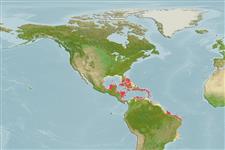
marin récifal; non migrateur; profondeur 0 - 10 m (Ref. 27000). Tropical; 33°N - 35°S, 98°W - 31°W
Western Atlantic: including southern Florida (USA), Bermuda, and northern Gulf of Mexico to Brazil.
Taille / Poids / Âge
Maturité: Lm ? range ? - ? cm
Max length : 10.0 cm TL mâle / non sexé; (Ref. 9710)
Description synthétique
Clés d'identification | Morphologie | Morphométrie
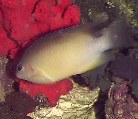
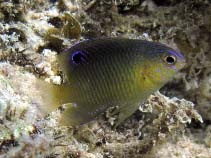
Épines dorsales (Total) : 12; Rayons mous dorsaux (Total) : 13 - 16; Épines anales: 2; Rayons mous anaux: 12 - 14. Caudal fin slightly forked, with rounded lobes. Dark blue or brown above, yellow below, without obvious narrow vertical lines. Dark spot near back of dorsal fin well above its base becomes smaller in larger fish (Ref. 26938).
Body shape (shape guide): short and / or deep; Cross section: compressed.
Adults occur in seagrass beds, coral or rocky reefs and sandy areas. Also found around mangrove shores and sponge beds; less common on flourishing coral reefs (Ref. 26938). They remain within 50 cm from the substrate. Adults feed on algae, polychaetes, amphipods, foraminiferans and gastropods while juveniles feed on harpacticoid copepods, nemerteans and polychaetes (Ref. 9626). Oviparous, distinct pairing during breeding (Ref. 205). Eggs are demersal and adhere to the substrate (Ref. 205). Males guard and aerate the eggs (Ref. 205). Caught incidentally in traps and small-meshed beach nets (Ref. 5217).
Cycle de vie et comportement reproducteur
Maturité | Reproduction | Frai | Œufs | Fécondité | Larves
Oviparous, distinct pairing during breeding (Ref. 205). Males guard and aerate the eggs (Ref. 205). The eggs are deposited inside empty shells or under stones or shell (Ref. 39478).
Allen, G.R., 1991. Damselfishes of the world. Mergus Publishers, Melle, Germany. 271 p. (Ref. 7247)
Statut dans la liste rouge de l'IUCN (Ref. 130435: Version 2025-2 (Global))
Menace pour l'homme
Harmless
Utilisations par l'homme
Pêcheries: commercial; Aquarium: Commercial
Outils
Fatal error: Uncaught mysqli_sql_exception: Too many connections in /var/www/html/includes/speciessummary.lib.php:1888
Stack trace:
#0 /var/www/html/includes/speciessummary.lib.php(1888): mysqli->__construct('mysql', 'fbuser', Object(SensitiveParameterValue), 'fbquizv2', '3306')
#1 /var/www/html/summary/SpeciesSummary.php(1851): checkRecordDisplayFBQuizV2('3651', 'PicList')
#2 {main}
thrown in /var/www/html/includes/speciessummary.lib.php on line 1888