>
Cichliformes (Cichlids, convict blennies) >
Cichlidae (Cichlids) > Cichlasomatinae
Etymology: Amatitlania: Named for the type locality of the type species; 'Amatitlán' means 'a place abundant in amate' in Nahuatl, 'amate' is a kind of rustic paper made from the bark of Ficus petiolaris or Ficus indica.
More on author: Günther.
Ambiente: milieu / zona climatica / distribuzione batimetrica / gamma di distribuzione
Ecologia
; acqua dolce benthopelagico; pH range: 7.0 - 8.0; dH range: 9 - 20. Tropical; 20°C - 36°C (Ref. 36880); 15°N - 8°N
Central America: Pacific slope, from Río Sucio, El Salvador to Río Suchiate, Guatemala; Atlantic slope, from Río Patuca, Honduras to Río Jutiapa, Guatemala. Not in slope to Panama (Am. coatepeque), Costa Rica or even Nicaragua (Am. siquia), as formerly considered. Introduced elsewhere.
Dimensione / Peso / Età
Maturità: Lm ? range ? - ? cm
Max length : 10.0 cm SL maschio/sesso non determinato; (Ref. 36377); common length : 8.5 cm TL maschio/sesso non determinato; (Ref. 12193)
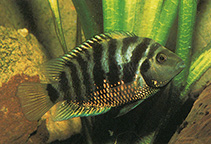
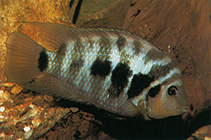
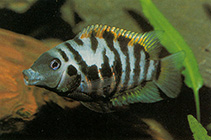
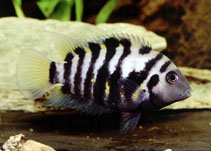
Spine dorsali (totale) : 17 - 19; Raggi dorsali molli (totale) : 7 - 9; Spine anali: 8 - 10; Raggi anali molli: 6 - 7; Vertebre: 27 - 28. This species is distinguished by the following characters: two (vs. one) distal rows of
interradial scales on anal fin; arms in the first epibranchial bone are parallel (vs. divergent); posterior end of dentigerous arm of dentary rounded or squarish (vs. triple-spined or bluntly pointed); peritoneal coloration is uniformly dark (vs. not uniformly dark); rostrad directed pronounced convexity on the ventral process of the articular absent (vs. present); body less deep than as compared with its congeners kanna and siquia; 4th bar not Y-shaped (Ref. 74403).
Body shape (shape guide): short and / or deep.
Adults inhabit flowing water from small creeks and streams to the shallows of large and fast flowing rivers (Ref. 7335). Prefer rocky habitats and finds sanctuary in the various cracks and crevices provided by this type of environment (Ref. 7335), or among roots and debris (Ref. 44091). They occur in warm pools of springs and their effluents (Ref. 7020). Feed on worms, crustaceans, insects, fish and plant matter (Refs. 7020; 44091). Also used in behavioral studies (Ref. 4537). Approximately 100-150 eggs are deposited and are vigorously guarded and cared for by both male and female (Ref. 44091). A popular aquarium fish which requires high temperature to maintain itself in an environment, e.g. artificially heated waters of power stations. Aquarium keeping: in pairs; minimum aquarium size 80 cm (Ref. 51539).
Ciclo vitale e comportamento di accoppiamento
Maturità | Riproduzione | Deposizione | Uova | Fecondità | Larve
Lays eggs on cleaned surfaces of rocks. Parents incubate eggs and guard young. Tends and fans the embryos and free embryos and transfers them several times into new pits excavated in the bottom using its mouth (huddling) (Ref. 34155).
Dark cavities are preferred as nests to conceal the brood and make them less conspicuous to visual predators (Ref. 38966). When in caves, single entrances are favored to reduce the probability of intrusion and are probably more manageable for the females in terms of defending their brood (Ref. 38966). Approximately 100-150 eggs are deposited and are vigorously guarded and cared for by both male and female (Ref. 44091).
Schmitter-Soto, J.J., 2007. A systematic revision of the genus Archocentrus (Perciformes: Cichlidae), with the description of two new genera and six new species. Zootaxa 1603:1-78. (Ref. 74403)
Stato della Lista Rossa IUCN (Ref. 130435: Version 2025-2 (Global))
Minaccia per l'uomo
Potential pest (Ref. 44091)
Usi umani
Pesca: di nessun interesse; Acquario: elevato interesse commerciale
Strumenti
Rapporti speciali
Scarica XML
Fonti Internet
Stime basate su modelli
Indice di diversità filogenetica (Fonte Biblio.
82804): PD
50 = 0.5020 [Uniqueness, from 0.5 = low to 2.0 = high].
Bayesian length-weight: a=0.02692 (0.01211 - 0.05983), b=3.02 (2.83 - 3.21), in cm total length, based on LWR estimates for this (Sub)family-body shape (Ref.
93245).
Livello trofico (Fonte Biblio.
69278): 3.3 ±0.45 se; based on food items.
Resilienza (Fonte Biblio.
120179): Alto, tempo minimo di raddoppiamento della popolazione meno di 15 mesi (tm<1 and multiple spawning events per year; Fec=100-150).
Vulnerabilità della pesca (Ref.
59153): Low vulnerability (13 of 100).
🛈