>
Acropomatiformes (Oceanic basses) >
Pempheridae (Sweepers)
Etymology: Pempheris: Greek, pempheris = the name of a fish (Ref. 45335).
Eponymy: Sir Robert Hermann Schomburgk (1804–1865) was a German businessman who was asked to supervise transporting Saxon sheep to Virginia, USA (1828), where he stayed. [...] (Ref. 128868), visit book page.
More on authors: Müller & Troschel.
Environnement : milieu / zone climatique / profondeur / gamme de distribution
Écologie
marin récifal; profondeur 3 - 30 m (Ref. 9710). Tropical
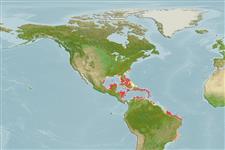
Western Atlantic: southeastern Florida, USA and Bahamas to Brazil.
Taille / Poids / Âge
Maturité: Lm ? range ? - ? cm
Max length : 15.0 cm TL mâle / non sexé; (Ref. 26340)
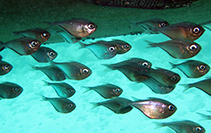
Épines dorsales (Total) : 5; Rayons mous dorsaux (Total) : 8 - 9; Épines anales: 3; Rayons mous anaux: 32 - 34. Ventral profile deeply curved in front of anal fin, tapering upward to slender caudal peduncle. Mouth very oblique (Ref. 26938). Scales ctenoid along the back posterior to dorsal fin and ventrally on head and body, otherwise cycloid, coppery with a dark band at base of anal fin; young nearly transparent, silvery over abdomen (Ref. 13442).
Body shape (shape guide): short and / or deep.
Occurs in clear water with coral bottom. Form aggregations in dark crevices and caves (Ref. 9710). Nocturnal (Ref. 9626). Its name probably refers to the juveniles, which are so transparent that the backbone can be seen in the living fish (Ref. 26938). Feeds on zooplankton, particularly the larval stages of invertebrates (Ref. 13442).
Cycle de vie et comportement reproducteur
Maturité | Reproduction | Frai | Œufs | Fécondité | Larves
Robins, C.R. and G.C. Ray, 1986. A field guide to Atlantic coast fishes of North America. Houghton Mifflin Company, Boston, U.S.A. 354 p. (Ref. 7251)
Statut dans la liste rouge de l'IUCN (Ref. 130435: Version 2025-2 (Global))
Menace pour l'homme
Harmless
Utilisations par l'homme
Pêcheries: d'intérêt potentiel; Aquarium: potentiel
Outils
Articles particuliers
Télécharger en XML
Sources Internet
Estimations basées sur des modèles
Température préférée (Réf.
123201): 25 - 28.1, mean 27.4 °C (based on 656 cells).
Indice de diversité phylogénétique (Réf.
82804): PD
50 = 0.5000 [Uniqueness, from 0.5 = low to 2.0 = high].
Bayesian length-weight: a=0.01413 (0.00715 - 0.02792), b=2.97 (2.80 - 3.14), in cm total length, based on LWR estimates for this species & Genus-body shape (Ref.
93245).
Niveau trophique (Réf.
69278): 3.1 ±0.0 se; based on diet studies.
Résilience (Réf.
120179): Haut, temps minimum de doublement de population inférieur à 15 mois (Preliminary K or Fecundity.).
Vulnérabilité de la pêche (Ref.
59153): Low vulnerability (10 of 100).
🛈
Nutriments (Ref.
124155): Calcium = 92.8 [48.0, 143.0] mg/100g; Iron = 0.717 [0.438, 1.149] mg/100g; Protein = 18.5 [17.3, 19.5] %; Omega3 = 0.115 [0.072, 0.181] g/100g; Selenium = 26.2 [15.2, 47.3] μg/100g; VitaminA = 73.7 [22.3, 236.3] μg/100g; Zinc = 1.47 [1.01, 2.09] mg/100g (wet weight);