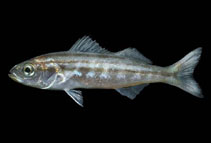
>
Eupercaria/misc (Various families in series Eupercaria) >
Haemulidae (Grunts) > Haemulinae
Etymology: Brachygenys: Name from Greek βραχυζ (Brachy), short and ϒενυζ (genys), chin; referring to the small snout of the these species.
More on author: Steindachner.
Entorno: milieu / zona climática / rango de profundidad / gama de distribución
Ecología
marino demersal; rango de profundidad 1 - 11 m (Ref. 2850). Subtropical; 37°N - 19°S, 123°W - 70°W
Eastern Pacific: USA (central California) to Mexico (Gulf of California).
Tamaño / Peso / Edad
Madurez: Lm ? range ? - ? cm
Max length : 30.0 cm TL macho / no sexado; (Ref. 9114); common length : 15.0 cm TL macho / no sexado; (Ref. 2850)
Occurs among rocks and high up in kelp beds (Ref. 2850). Usually in schools (Ref. 2850). Primarily nocturnal feeders but occasionally forage during the day. Although the species is a good foodfish, it is of limited interest due to its small size.
Ciclo vital y comportamiento de apareamiento
Madurez | Reproducción | Puesta | Huevos | Fecundidad | Larva
Oviparous, distinct pairing during breeding (Ref. 205).
Eschmeyer, W.N., E.S. Herald and H. Hammann, 1983. A field guide to Pacific coast fishes of North America. Boston (MA, USA): Houghton Mifflin Company. xii+336 p. (Ref. 2850)
Situación en la Lista Roja de la UICN (Ref. 130435: Version 2025-2 (Global))
Amenaza para el ser humano
Harmless
Usos humanos
Pesquerías: escaso valor comercial
Herramientas
Informes especiales
Descargar XML
Fuentes de Internet
Estimaciones basadas en modelos
Temperatura preferida (Referencia
123201): 19.3 - 29, mean 24.2 °C (based on 267 cells).
Índice de diversidad filogenética (Referencia
82804): PD
50 = 0.5625 [Uniqueness, from 0.5 = low to 2.0 = high].
Bayesian length-weight: a=0.01318 (0.00637 - 0.02726), b=2.98 (2.81 - 3.15), in cm total length, based on LWR estimates for this (Sub)family-body shape (Ref.
93245).
Nivel trófico (Referencia
69278): 3.5 ±0.3 se; based on size and trophs of closest relatives
Resiliencia (Referencia
120179): Medio, población duplicada en un tiempo mínimo de 1.4-4.4 años (Preliminary K or Fecundity.).
Vulnerabilidad pesquera (Ref.
59153): Low vulnerability (20 of 100).
🛈