>
Eupercaria/misc (Various families in series Eupercaria) >
Haemulidae (Grunts) > Haemulinae
Etymology: Anisotremus: Greek, anisos = unequal + Greek, trema, -atos = hole (Ref. 45335).
Eponymy: George Davidson (1825–1911) was a geodesist, astronomer, geographer, surveyor, engineer and revered colleague of the author who became the President of the California Academy of Sciences (1871–1887). [...] (Ref. 128868), visit book page.
More on author: Steindachner.
Entorno: milieu / zona climática / rango de profundidad / gama de distribución
Ecología
marino demersal; rango de profundidad 0 - 40 m (Ref. 2850), usually ? - 8 m (Ref. 2850). Subtropical; 39°N - 22°N, 124°W - 106°W
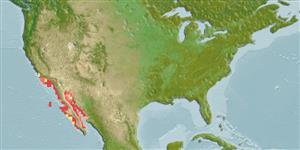
Eastern Central Pacific: Santa Cruz in central California, USA to southern Baja California, Mexico; isolated population in the Gulf of California.7
Tamaño / Peso / Edad
Madurez: Lm ? range ? - ? cm
Max length : 58.0 cm TL macho / no sexado; (Ref. 2850); edad máxima reportada: 15 años (Ref. 56049)
Descripción breve
Claves de identificación | Morfología | Morfometría
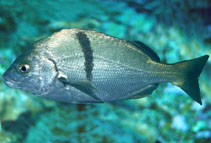
Occur in coastal waters, frequently in rocky reefs and occasionally over sandy bottoms (Ref. 9114); often near kelp beds. Juveniles form schools in littoral pools (Ref. 9114). Feed on crustaceans, mollusks and bryozoans. Pelagic spawner (Ref. 56049). Marketed fresh (Ref. 9114).
Ciclo vital y comportamiento de apareamiento
Madurez | Reproducción | Puesta | Huevos | Fecundidad | Larva
Distinct pairing during breeding (Ref. 205). Pelagic spawner (Ref. 56049).
Eschmeyer, W.N., E.S. Herald and H. Hammann, 1983. A field guide to Pacific coast fishes of North America. Boston (MA, USA): Houghton Mifflin Company. xii+336 p. (Ref. 2850)
Situación en la Lista Roja de la UICN (Ref. 130435: Version 2025-2 (Global))
Amenaza para el ser humano
Harmless
Usos humanos
Pesquerías: escaso valor comercial; pesca deportiva: si
Herramientas
Informes especiales
Descargar XML
Fuentes de Internet
Estimaciones basadas en modelos
Temperatura preferida (Referencia
123201): 15.2 - 23.3, mean 21.1 °C (based on 116 cells).
Índice de diversidad filogenética (Referencia
82804): PD
50 = 0.5020 [Uniqueness, from 0.5 = low to 2.0 = high].
Bayesian length-weight: a=0.01660 (0.00764 - 0.03607), b=3.02 (2.84 - 3.20), in cm total length, based on LWR estimates for this (Sub)family-body shape (Ref.
93245).
Nivel trófico (Referencia
69278): 3.5 ±0.46 se; based on food items.
Resiliencia (Referencia
120179): Medio, población duplicada en un tiempo mínimo de 1.4-4.4 años (tm=2; tmax=15).
Vulnerabilidad pesquera (Ref.
59153): Moderate vulnerability (43 of 100).
🛈
Nutrientes (Ref.
124155): Calcium = 66.6 [18.1, 143.9] mg/100g; Iron = 0.994 [0.509, 2.109] mg/100g; Protein = 19 [17, 21] %; Omega3 = 0.238 [0.117, 0.441] g/100g; Selenium = 26.6 [12.7, 56.7] μg/100g; VitaminA = 6.35 [1.96, 20.67] μg/100g; Zinc = 0.595 [0.380, 0.906] mg/100g (wet weight);