>
Eupercaria/misc (Various families in series Eupercaria) >
Priacanthidae (Bigeyes or catalufas)
Eponymy: Dr Charles Montague Cooke Jr (1874–1948) was a malacologist at the Bishop Museum, Hawaii and Curator of the snail collection (1902–1948). [...] (Ref. 128868), visit book page.
More on author: Cuvier.
Milieu: milieu / Klimaatzone / Diepte / verspreidingsgebied
Ecologie
marien rifbewoner; diepte 40 - 400 m (Ref. 9335), usually 165 - 200 m (Ref. 9335). Subtropical; 46°N - 56°S, 25°E - 5°W
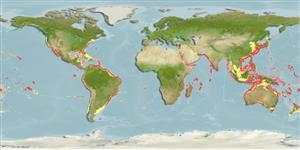
Circumglobal in tropical and tropically influenced seas. Indo-Pacific: South Africa to the central Pacific islands, north to Japan and Korea, south to southeastern Australia. Eastern Pacific: Baja California to Peru. Western Atlantic: Nova Scotia, Canada (Ref. 47377) and New Jersey, USA to probably Argentina (Ref. 11441). Abundant at St. Helena but no substantiated records in eastern Atlantic from the African coastal region or the Canary Islands. Often misidentified as Cookeolus boops, a junior synonym of Heteropriacanthus cruentatus (Ref. 11441).
Grootte / Gewicht / Leeftijd
Maturiteit: Lm ? range ? - ? cm
Max length : 69.0 cm NG mannelijk / geslacht onbekend; (Ref. 89467); common length : 30.0 cm TL mannelijk / geslacht onbekend; (Ref. 5217); max. gepubliceerd gewicht: 5.0 kg (Ref. 89467); max. gerapporteerde leeftijd: 9 Jaren (Ref. 5403)
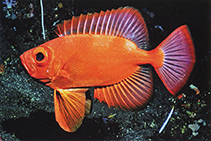
Dorsale stekels (totaal) : 10; Dorsale zachte stralen (totaal) : 12 - 14; Anale stekels: 3; Anale zachte stralen: 12 - 14. Last (10th) dorsal spine twice the length of the second (Ref. 48635).
Body shape (shape guide): fusiform / normal; Cross section: compressed.
Found on hard bottoms to a depth of about 400 m and reported to be moderately common at depths of 165 to 260 m in association with rocky holes and ledges; preferably with rich invertebrate growth such as sponges and soft corals (Ref. 48635). Benthopelagic (Ref. 58302). Juveniles pelagic (Ref. 9335, 9563). Feed on pelagic crustaceans (Ref. 9335). Probably spawns in the Caribbean from May to September. Solitary (Ref 90102).
Levenscyclus en paargedrag
Maturiteit | Voortplanting | Paaien | Eieren | Fecunditeit | Larven
Starnes, W.C., 1988. Revision, phylogeny and biogeographic comments on the circumtropical marine percoid fish family Priacanthidae. Bull. Mar. Sci. 43(2):117-203. (Ref. 5403)
Status op de Rode Lijst van het IUCN (Ref. 130435: Version 2025-2 (Global))
Gevaar voor de mens
Harmless
Gebruik door de mens
Visserij: commercieel; sportvis: ja; Aquarium: Commercieel
Tools
Speciale rapporten
Download XML
Internetbronnen
Schattingen op basis van modellen
Gewenste temperatuur (Ref.
123201): 12.2 - 21.8, mean 15.6 °C (based on 136 cells).
Fylogenetische diversiteitsindex (Ref.
82804): PD
50 = 1.0000 [Uniqueness, from 0.5 = low to 2.0 = high].
Bayesian length-weight: a=0.02042 (0.01066 - 0.03911), b=2.89 (2.73 - 3.05), in cm total length, based on LWR estimates for this species & (Sub)family-body (Ref.
93245).
Trofisch niveau (Ref.
69278): 3.5 ±0.60 se; based on food items.
Weerstandsvermogen (Ref.
120179): Gemiddeld, minimale populatieverdubbelingstijd 1,4-4,4 jaar (tmax=9).
Kwetsbaarheid van de visserij (Ref.
59153): Low vulnerability (25 of 100).
🛈
Voedingsstoffen (Ref.
124155): Calcium = 24.3 [12.8, 50.6] mg/100g; Iron = 0.604 [0.353, 1.029] mg/100g; Protein = 20.1 [19.1, 21.1] %; Omega3 = 0.252 [0.148, 0.416] g/100g; Selenium = 30.1 [15.0, 57.6] μg/100g; VitaminA = 21.4 [7.2, 67.6] μg/100g; Zinc = 0.605 [0.411, 0.914] mg/100g (wet weight);