>
Carangaria/misc (Various families in series Carangaria) >
Latidae (Lates perches)
Etymology: Lates: Latin, lateo, latere = to be hidden.
More on author: Linnaeus.
Miljö: miljö / Klimatzon / djupintervall / distributionsområde
Ekologi
; sötvatten bottenlevande; flodvandrande (Ref. 51243); djupintervall 10 - 60 m (Ref. 34290). Tropical; 27°N - 7°S
Africa: widespread throughout the Nilo-Sudan region of Africa, occurring commonly in all major river basins including Senegal, Niger, Volta, Chad (Ref. 81285, 81652) and Nile (Ref. 3636, 28714, 81652). Found almost everywhere in West Africa, except in Gambia (Ref. 81285). Also present in the Congo basin and lakes Albert, Turkana/Rudolph and Tana (Ref. 3636). Several countries report adverse ecological impact after introduction.
Längd vid första mognad / Storlek / Vikt / Ålder
Könsmognad: Lm 75.7, range 53 - 85 cm
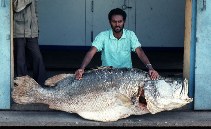
Max length : 200 cm TL hane/ej könsbestämd; (Ref. 58490); common length : 100.0 cm SL hane/ej könsbestämd; (Ref. 34290); publicerad maxvikt: 200.0 kg (Ref. 3900)
Kort beskrivning
Bestämningsnycklar | Morfologi | Morfometri
Taggstrålar i ryggfenan (totalt) : 7 - 8; Mjukstrålar i ryggfenan (totalt) : 8 - 14; Taggstrålar i analfenan: 3; Mjukstrålar i analfenan: 7 - 9. Diagnosis: mouth large and protrusible (Ref. 28714, 81285, 81652), lower jaw (slightly) prominent (Ref. 81285, 81652). Numerous villiform teeth present in jaws, on palate (Ref. 81285, 81652) and vomer (Ref. 81652). Preorbital/lachrymal (Ref. 4967, 81652) and preopercle (Ref. 4967, 81285, 81652) denticulate. Strong, prominent opercular spine present (Ref. 4967, 81285, 81652) on free edge of opercle, and a smaller one dorsal to it (Ref. 81652). Dorsal fin divided by a deep notch into anterior spiny and posterior soft-rayed sections; anal fin with 3 spines; pelvics with a spine and situated close to the pectorals (Ref. 28714). Caudal fin rounded (Ref. 4967, 81285, 81652). Scales ctenoid, 54-74 along lateral line, followed by 6-8 pored scales on caudal-fin base; ceratobranchial (lower limb) of first gill arch with 12-14 gill rakers (Ref. 81285).
Coloration: body uniformly silvery (Ref. 81285) or dark greyish-blue dorsally, greyish-silver on flank and ventrally (Ref. 34290, 81652). Fins greyish; interior of eye conspicuously yellowish (Ref. 81285). Juveniles brownish with lighter marbling (Ref. 81285) on head and flanks (Ref. 81652).
Body shape (shape guide): fusiform / normal; Cross section: compressed.
Inhabits channels, lakes and irrigation canals (Ref. 28714, 81652). Adults inhabit deep water, while juveniles are found in shallow water (Ref. 81652). Feeds on fish especially clupeids and Alestes (Ref. 13851). Smaller fish also feed on larger crustaceans and insects; juveniles are planktivorous (Ref. 28714). Threatened due to over harvesting (Ref. 58490). No length type given but assumed to be in TL. Maximum reported size of 180.0 cm corresponding to a weight of 164 kg in Lake Albert (Ref. 81285).
Teugels, G.G., C. Lévêque, D. Paugy and K. Traoré, 1988. État des connaissances sur la faune ichtyologique des bassins côtiers de Côte d'Ivoire et de l'ouest du Ghana. Rev. Hydrobiol. Trop. 21(3):221-237. (Ref. 272)
Status på IUCN:s rödlista (Ref. 130435: Version 2025-2 (Global))
Hot mot människor
Potential pest
Mänskliga användningsområden
Fiskeri: kommersiellt viktig; Vattenbruk: kommersiell; sportfisk: ja
Verktyg
Särskilda rapporter
Ladda ner XML
Internet-källor
Uppskattningar baserade på modeller
Index för fylogenetisk mångfald (Ref.
82804): PD
50 = 0.5005 [Uniqueness, from 0.5 = low to 2.0 = high].
Bayesian length-weight: a=0.00977 (0.00773 - 0.01236), b=3.00 (2.94 - 3.06), in cm total length, based on LWR estimates for this species (Ref.
93245).
Trofisk nivå (Ref.
69278): 4.5 ±0.8 se; based on diet studies.
Resiliens (Ref.
120179): Mellan, lägsta populationsfördubblingstid 1,4-4,4 år (K=0.17-0.19; tm=2-3).
Sårbarhet i fisket (Ref.
59153): Moderate to high vulnerability (47 of 100).
🛈
Näringsämnen (Ref.
124155): Calcium = 107 [24, 225] mg/100g; Iron = 1.42 [0.71, 3.32] mg/100g; Protein = 20 [19, 22] %; Omega3 = 0.385 [0.158, 0.967] g/100g; Selenium = 216 [57, 655] μg/100g; VitaminA = 18.9 [4.3, 99.4] μg/100g; Zinc = 0.698 [0.288, 1.528] mg/100g (wet weight); based on
nutrient studies.