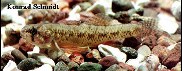
>
Perciformes/Percoidei (Perchs) >
Percidae (Perches) > Etheostomatinae
Etymology: Etheostoma: Greek, etheo = to strain + Greek, stoma = mouth; Rafinesque said "various mouths", but Jordan and Evermann suggest the name might have been intended as "Heterostoma (Ref. 45335); microperca: From the words micro, meaning small, and perca, perch (Ref. 10294).
More on authors: Jordan & Gilbert.
Environnement : milieu / zone climatique / profondeur / gamme de distribution
Écologie
; eau douce benthopélagique; pH range: 7.0 - 7.8; dH range: ? - 15. Temperate; 10°C - 22°C (Ref. 12468); 47°N - 34°N
North America: Great Lakes and Mississippi River basins from eastern Ontario in Canada and from Minnesota south to southern Ohio, central Indiana and central Illinois in the USA; Ozarks-Ouachita drainages of southern Missouri, southeastern Kansas, northwestern Arkansas and eastern Oklahoma in the USA.
Taille / Poids / Âge
Maturité: Lm ? range ? - ? cm
Max length : 4.4 cm TL mâle / non sexé; (Ref. 5723); common length : 3.1 cm TL mâle / non sexé; (Ref. 12193); âge max. reporté: 2.00 années (Ref. 12193)
Occur in quiet, vegetated lakes, headwaters, creeks and small rivers (Ref. 5723); also found in streams and springs to ponds (Ref. 10294). Usually found over mud and sand (Ref. 5723, 10294). Adults feed on midge larvae, isopods, and microcrustaceans, particularly copepods (Ref. 10294). Eggs are found attached to the substrate unguarded (Ref. 7043).
Eggs are found attached to the substrate unguarded (Ref. 7043). From Ref. 7043, 'a ripe female is courted by males and when ready to spawn positions herself on vegetation, often vertically. A male mounts the female and clasps her back with his enlarged pelvic fins. The two fish vibrate and one to three eggs are deposited on living or dead vegetation.The pair moves to another spot and more eggs are laid.'
Page, L.M. and B.M. Burr, 1991. A field guide to freshwater fishes of North America north of Mexico. Houghton Mifflin Company, Boston. 432 p. (Ref. 5723)
Statut dans la liste rouge de l'IUCN (Ref. 130435: Version 2025-2 (Global))
Menace pour l'homme
Harmless
Utilisations par l'homme
Outils
Articles particuliers
Télécharger en XML
Sources Internet
Estimations basées sur des modèles
Indice de diversité phylogénétique (Réf.
82804): PD
50 = 0.5000 [Uniqueness, from 0.5 = low to 2.0 = high].
Bayesian length-weight: a=0.00676 (0.00303 - 0.01510), b=3.12 (2.94 - 3.30), in cm total length, based on LWR estimates for this Genus-body shape (Ref.
93245).
Niveau trophique (Réf.
69278): 3.5 ±0.50 se; based on food items.
Résilience (Réf.
120179): Haut, temps minimum de doublement de population inférieur à 15 mois (tm=1; tmax=2; Fec=31-240).
Vulnérabilité de la pêche (Ref.
59153): Low vulnerability (10 of 100).
🛈