>
Carangaria/misc (Various families in series Carangaria) >
Polynemidae (Threadfins)
Etymology: Eleutheronema: Greek, eleutheros = free + Greek, nema = filament (Ref. 45335).
More on author: Shaw.
محیط زیست: محیط زیست / منطقه آب و هوایی / تغييرات عمق / محدوده توزیع
بوم شناسي
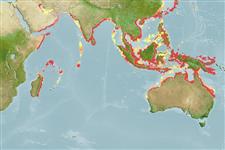
دريايي; آب شيرين; لب شور pelagic-neritic; هردو رو (Ref. 51243); تغييرات عمق 0 - 23 m (Ref. 6390). Tropical; 32°N - 26°S, 47°E - 154°E (Ref. 57343)
Indo-Pacific: Persian/Arabian Gulf, Pakistan, India and Sri Lanka (except the Red Sea and East Africa) to northern Australia and New Guinea. Replaced by Eleutheronema rhadinum (Jordan & Evermann, 1902), in East Asia (Japan, China, Viet Nam) (Ref. 41639).
طول در اولین بلوغ / اندازه / وزن / سن
بلوغ: Lm ?, range 29 - ? cm
Max length : 200 cm TL جنس نر / بدون خواص جنسي; (Ref. 3479); common length : 50.0 cm TL جنس نر / بدون خواص جنسي; (Ref. 3479); بيشينه وزن گزارش شده: 145.0 kg (Ref. 4965)
خارهاي باله پشتي (کل) : 9; شعاع نرم باله پشتي (کل) : 13 - 15; خارهاي باله مخرجي: 3; شعاع نرم باله مخرجي: 14 - 16; مهره ها: 25. This species is distinguished with the following characters: second dorsal fin soft rays 14 (rarely 13 or 15) pectoral fin rays 16-18 (mode 17, rarely 15 or 19), pectoral filaments 4; pored
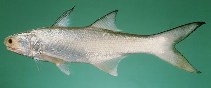
lateral line scales 71-80 (mode 73); scale rows above lateral line 9-12, below 13-15 (14); vomer with deciduous tooth plates on both sides, except in juveniles (< ca. 7.0 cm SL); posterior part of maxilla deep, 3-4% of SL; short tooth plate extension onto lateral surface of lower jaw, 7-9% SL. Colour of upper sides of head and trunk with slight darkish silver tinge, becoming lighter in lower sides; anterior margins of first and second dorsal fins blackish, remaining parts translucent and slightly blackish, respectively; pectoral fin membranes vivid yellow in life, except in large specimens > ca 35 cm SL which is dusky yellow; pectoral filaments white; anterior margin of pelvic fin yellow and other parts white; base of caudal fin yellowish, other parts blackish (Ref. 41639, 57343).
Body shape (shape guide): elongated; Cross section: compressed.
Adults occur mainly over shallow muddy bottoms in coastal waters. Also enter rivers (Ref. 3479, 6390, 11230). Juveniles found in estuaries. During winter, adults ascend the rivers. They usually form loose schools, although larger fish are more often observed in pairs or singly (Ref. 6390). Feed on prawns and fish (largely members of Mugilidae, Engraulidae, and Sciaenidae) with occasional polychaetes. Frequency of crustaceans to fish in the diet varies seasonally. Larvae (7-30 mm TL) feed mainly on copepods and mysids but also take shrimps and prawn larvae (Ref. 57343). Juveniles (31-60 TL) feed on prawns shrimps and mysids (Ref. 57343). Protandrous hermaphrodites. Marketed fresh, frozen, and dried or salted.
In Australia, fish are males at 24-47 cm FL, hermaphrodites at 25-46 cm FL and females at 28-72 cm FL. On the northeast Queensland coast, most blue threadfin are females by 45-50 cm FL. Hermaphroditic blue threadfin develop fom 1-2-year-old fish, and females first appear as 2-3-year-old individuals (Ref. 28736). Male fish probably commence sex reversal immediately after spawning (ie about April-May) and this condition may persist until after the next spawning period (Ref. 28736). The progression from hermaphrodites to females is complete by the following season.
There is little information on the larvae, although nursery areas are known to be lower estuaries, tidal swamps and lagoons, and shallows along the foreshores (Williams 1997).
Motomura, H., Y. Iwatsuki, S. Kimura and T. Yoshino, 2002. Revision of the Indo-West Pacific polynemid fish genus Eleutheronema (Teleostei: Perciformes). Ichthyol. Res. 49(1):47-61. (Ref. 41639)
وضعيت در فهرست قرمز IUCN (Ref. 130435: Version 2025-2 (Global))
خطر برای انسان ها
Harmless
استفاده انسانی
ماهي گيري – شيلات: با ارزش تجاري بالا; آبزي پروري: تجاري
ابزارها
گزارش های ويژه
بارگيری XML
منابع اينترنتي
تخمینها بر اساس مدلها
دمای ترجیحی (مرجع
123201): 25.2 - 29.3, mean 28.6 °C (based on 2815 cells).
شاخص تنوع فیلوژنتیکی (مرجع
82804): PD
50 = 0.6250 [Uniqueness, from 0.5 = low to 2.0 = high].
Bayesian length-weight: a=0.00617 (0.00478 - 0.00796), b=3.07 (3.00 - 3.14), in cm total length, based on LWR estimates for this species (Ref.
93245).
سطح تروفیک (مرجع
69278): 4.1 ±0.5 se; based on diet studies.
جهندگی (مرجع
120179): متوسط, كمينه زمان لازم براي دو برابر شدن جمعيت 4/1 – 4/4 سال (Fec=680,000; assuming tm>=2).
Prior r = 0.56, 95% CL = 0.37 - 0.84, Based on 2 data-limited stock assessments.
آسیبپذیری ماهیگیری (Ref.
59153): Very high vulnerability (90 of 100).
🛈
آسیبپذیری اقلیمی (Ref.
125649): Very high vulnerability (91 of 100).
🛈
مواد مغذی (Ref.
124155): Calcium = 38.1 [12.5, 117.4] mg/100g; Iron = 0.744 [0.292, 1.866] mg/100g; Protein = 20 [18, 22] %; Omega3 = 0.122 [0.065, 0.224] g/100g; Selenium = 52.9 [18.1, 162.0] μg/100g; VitaminA = 15.1 [5.7, 40.9] μg/100g; Zinc = 0.92 [0.46, 1.74] mg/100g (wet weight); based on
nutrient studies.