>
Centrarchiformes (Basses) >
Centrarchidae (Sunfishes)
Etymology: Micropterus: Greek, mikros = small + Greek,pteron = wing, fin (Ref. 45335); coosae: Specific epithet coosae: of the Coosa (river system) (Ref. 10294).
More on authors: Hubbs & Bailey.
Miljö: miljö / Klimatzon / djupintervall / distributionsområde
Ekologi
; sötvatten bottenlevande. Temperate; 35°N - 33°N
North America: Savannah, Chattahoochee and Mobile Bay basins in North Carolina, South Carolina, Georgia, Tennessee and Alabama in the USA.
Storlek / Vikt / Ålder
Könsmognad: Lm ? range ? - ? cm
Max length : 47.0 cm TL hane/ej könsbestämd; (Ref. 5723); common length : 25.5 cm TL hane/ej könsbestämd; (Ref. 12193); publicerad maxvikt: 3.7 kg (Ref. 4699); rapporterad maxålder: 10 år (Ref. 72462)
Kort beskrivning
Bestämningsnycklar | Morfologi | Morfometri
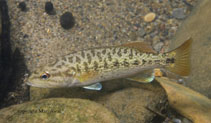
Taggstrålar i ryggfenan (totalt) : 10; Mjukstrålar i ryggfenan (totalt) : 12 - 14; Taggstrålar i analfenan: 3; Mjukstrålar i analfenan: 10 - 11. A member of Micropterus coosae species group but differs from all other members of the group by having red on the distal one-half of second-dorsal, caudal, and anal fins, and entire length of pectoral-fin rays (vs. green, yellow-green, or orange on smaller portions of fins in other species) and midline row of blotches partial to lacking, typically with 6 or fewer anterior vertical blotches with the remainder too diffuse to recognize as blotches or spots (in 76% of individuals; remaining 24% with midline row of blotches extending total body length, having 10-13 blotches). It further differs from M. tallapoosae and M. chattahoochae by a combination of the following characters: smaller scales (2.6 vs. 2.9% SL); higher scale counts, including lateral-line scales (mode 70 vs. 65 or 66; range 68-73 in 83.8% vs. 61-67 in 77.2%), and scale rows around caudal peduncle (mode = 30 vs. 29; range 30-32 in 80.0% vs. 26-29 in 94.1%). It can be further separated from M. warriorensis by the presence of a tooth patch (vs. absent; from M. tallapoosae, M. warriorensis, M. cahabae, M. chattahoochae, and M. cf. coosae (Savannah River) by a narrower postfrontal width 11.0% SL (vs. 11.2% SL or more); and from M. cahabae by the presence of more pronounced white tips on the caudal fin (Ref. 93229).
Body shape (shape guide): fusiform / normal.
Inhabits rocky runs and pools of creeks and small to medium rivers (Ref. 205); also found in upland streams (Ref. 10294). Oviparous (Ref. 205).
Livscykel och parningsbeteende
Könsmognad | Reproduktion | Lek | Ägg | Fekunditet | Larver
Breed in shallow ponds, lakes or creeks (Ref. 205). Distinct pairing (Ref. 205). Oviparous (Ref. 205).
Page, L.M. and B.M. Burr, 1991. A field guide to freshwater fishes of North America north of Mexico. Houghton Mifflin Company, Boston. 432 p. (Ref. 5723)
Status på IUCN:s rödlista (Ref. 130435: Version 2025-2 (Global))
Hot mot människor
Harmless
Mänskliga användningsområden
Fiskeri: husbehovsfiske; sportfisk: ja
Verktyg
Särskilda rapporter
Ladda ner XML
Internet-källor
Uppskattningar baserade på modeller
Index för fylogenetisk mångfald (Ref.
82804): PD
50 = 0.5000 [Uniqueness, from 0.5 = low to 2.0 = high].
Bayesian length-weight: a=0.01072 (0.00638 - 0.01801), b=3.05 (2.90 - 3.20), in cm total length, based on LWR estimates for this species & (Sub)family-body (Ref.
93245).
Trofisk nivå (Ref.
69278): 3.6 ±0.5 se; based on size and trophs of closest relatives
Resiliens (Ref.
120179): Mellan, lägsta populationsfördubblingstid 1,4-4,4 år (Preliminary K or Fecundity.).
Sårbarhet i fisket (Ref.
59153): Moderate vulnerability (37 of 100).
🛈