>
Mugiliformes (Mullets) >
Mugilidae (Mullets)
Etymology: Joturus: Taken from the Greek letter "iota" = the least or in the very small quantity + Greek, oura = tail (Ref. 45335).
Eponymy: Esteban Pichardo (1799–1879) was a Cuban lexicographer-geographer who was, according to Poey, the ‘estimable auteur’ of Diccionario Provincial de voces Cubanos and Geografia de la isla de Cuba (he also recommended the vernacular name Joturo). (Ref. 128868), visit book page.
More on author: Poey.
Umwelt: Milieu / Klimazone / Tiefenbereich / Verbreitungsgebiet
Ökologie
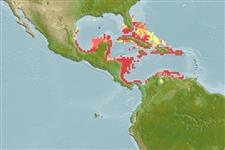
seewasser; süßwasser; brackwasser pelagic-neritic; katadrom (Ref. 51243); tiefenbereich 10 - ? m. Subtropical; 22°C - 25°C (Ref. 36880); 30°N - 7°N, 112°W - 65°W
Central America: Bahamas and Greater Antilles and the Atlantic and Pacific slopes of Central America and Colombia.
Größe / Gewicht / Alter
Geschlechtsreife: Lm ? range ? - ? cm
Max length : 61.0 cm TL Männchen/unbestimmt; (Ref. 9321); common length : 25.0 cm TL Männchen/unbestimmt; (Ref. 9321); max. veröff. Gewicht: 3.3 kg (Ref. 40637)
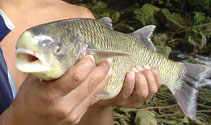
Adults inhabit the upper reaches of rivers but enter brackish waters where spawning probably occurs. An important food fish in some areas. Herbivorous and scrapes algae from stones on the bottom with its fleshy lips, although sometimes eats prawns (Ref. 36880). Oviparous, eggs are pelagic and non-adhesive (Ref. 205). Migrate from the upper reaches of rivers during months of high rainfall to the sea-river transition zone to spawn (Ref. 13802).
Lebenszyklus und Paarungsverhalten
Geschlechtsreife | Fortpflanzung | Ablaichen | Eier | Fruchtbarkeit | Larven
Harrison, I.J., 1995. Mugilidae. Lisas. p. 1293-1298. In W. Fischer, F. Krupp, W. Schneider, C. Sommer, K.E. Carpenter and V. Niem (eds.) Guia FAO para Identification de Especies para lo Fines de la Pesca. Pacifico Centro-Oriental. 3 Vols. FAO, Rome. (Ref. 9321)
IUCN Rote Liste Status (Ref. 130435: Version 2025-2 (Global))
Bedrohung für Menschen
Harmless
Nutzung durch Menschen
Fischereien: kleinfischerei
Tools
Zusatzinformationen
Download XML
Internet Quellen
Schätzungen auf der Grundlage von Modellen
Bevorzugte Temperatur (Ref.
123201): 27.5 - 28.4, mean 28 °C (based on 223 cells).
Phylogenetischer Diversitätsindex (Ref.
82804): PD
50 = 1.0000 [Uniqueness, from 0.5 = low to 2.0 = high].
Bayesian length-weight: a=0.01175 (0.00553 - 0.02496), b=2.96 (2.79 - 3.13), in cm total length, based on LWR estimates for this (Sub)family-body shape (Ref.
93245).
Trophische Ebene (Ref.
69278): 2.9 ±0.37 se; based on food items.
Widerstandsfähigkeit (Ref.
120179): mittel, Verdopplung der Population dauert 1,4 - 4,4 Jahre. (Assuming tm=2).
Anfälligkeit der Fischerei (Ref.
59153): Moderate vulnerability (44 of 100).
🛈
Klimaanfälligkeit (Ref.
125649): Very high vulnerability (88 of 100).
🛈
Nährstoffe (Ref.
124155): Calcium = 80.4 [31.3, 190.5] mg/100g; Iron = 1.2 [0.6, 2.7] mg/100g; Protein = 19.4 [17.7, 21.0] %; Omega3 = 0.501 [0.239, 1.087] g/100g; Selenium = 18.3 [9.2, 38.9] μg/100g; VitaminA = 11.5 [3.4, 41.2] μg/100g; Zinc = 1.08 [0.76, 1.61] mg/100g (wet weight);