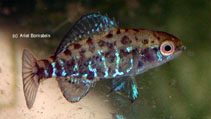
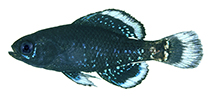
Environnement : milieu / zone climatique / profondeur / gamme de distribution
Écologie
; eau douce démersal; pH range: 6.0 - ? ; dH range: 5 - ?. Temperate; 4°C - 30°C (Ref. 2060); 32°N - 28°N
North America: Lower Altamaha River drainage, Georgia south to central part of peninsular Florida, and west to Choctawhatchee River drainage, Florida, USA.
Taille / Poids / Âge
Maturité: Lm ? range ? - ? cm
Max length : 3.4 cm TL mâle / non sexé; (Ref. 5723); common length : 2.3 cm TL mâle / non sexé; (Ref. 12193)
Description synthétique
Clés d'identification | Morphologie | Morphométrie
Body shape (shape guide): fusiform / normal; Cross section: oval.
Occurs in swamps, heavily vegetated sloughs and small sluggish streams, usually over mud. Oviparous, eggs are deposited in aquatic vegetation, preferably on strands of Ceratophyllum sp. when available (Ref. 58020).
Cycle de vie et comportement reproducteur
Maturité | Reproduction | Frai | Œufs | Fécondité | Larves
The fish scatter their eggs into thick plant vegetation.
Page, L.M. and B.M. Burr, 1991. A field guide to freshwater fishes of North America north of Mexico. Houghton Mifflin Company, Boston. 432 p. (Ref. 5723)
Statut dans la liste rouge de l'IUCN (Ref. 130435: Version 2025-2 (Global))
Menace pour l'homme
Harmless
Utilisations par l'homme
Outils
Articles particuliers
Télécharger en XML
Sources Internet
Estimations basées sur des modèles
Indice de diversité phylogénétique (Réf.
82804): PD
50 = 0.5156 [Uniqueness, from 0.5 = low to 2.0 = high].
Bayesian length-weight: a=0.01122 (0.00514 - 0.02450), b=3.04 (2.87 - 3.21), in cm total length, based on all LWR estimates for this body shape (Ref.
93245).
Niveau trophique (Réf.
69278): 3.4 ±0.4 se; based on size and trophs of closest relatives
Résilience (Réf.
120179): Faible, temps minimum de doublement de population : 4,5 à 14 années (Fec=20).
Vulnérabilité de la pêche (Ref.
59153): Low vulnerability (10 of 100).
🛈