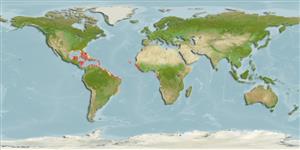
Ambiente: milieu / zona climatica / distribuzione batimetrica / gamma di distribuzione
Ecologia
marino demersale; distribuzione batimetrica 1 - 26 m (Ref. 89885), usually 1 - 2 m (Ref. 89885). Tropical
Western Atlantic: Eastern Atlantic and Brazilian populations need further investigation, (including morphological and genetic), to determine if they represent R. subbifrenatus or undescribed species (Ref. 89885).
Dimensione / Peso / Età
Maturità: Lm ? range ? - ? cm
Max length : 18.0 cm TL maschio/sesso non determinato; (Ref. 7251)
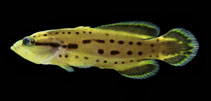
Spine dorsali (totale) : 3 - 4; Raggi dorsali molli (totale) : 21 - 25; Spine anali: 1; Raggi anali molli: 11 - 13. This species is distinguished from its congeners by the following set of characters: pectoral fin and distal portions of soft dorsal, caudal, and anal fins are tan to brown in life and when preserved; numerous dark spots on head and trunk; spots on head posterior to horizontal through center of orbit usually prominent, round or oblong, and one or more usually equal in size to or larger than diameter of pupil; posterior portion of interorbital region usually with 2 pairs of spots (sometimes joined as a stripe), spots directly on or abutting orbital rim; belly and caudal fin usually without spots; D III or IV (nearly bimodal), total dorsal-fin elements modally 26; pectoral fin rays modally 16; total caudal-fin rays modally 25; lower jaw extending anteriorly beyond upper jaw, mean difference between distance from tip of lower jaw to orbit and tip of upper jaw to orbit 4% HL; caudal peduncle relatively wide, average depth 13% SL (Ref. 89885).
Body shape (shape guide): fusiform / normal.
Inhabits clear tropical waters to depths of 26 m, but it is found most commonly at 1-2 m (mean maximum depth of specimens collected is 5 m, only 6 were captured deeper than 15 m). Lives in tide pools, among coral rubble, in patch reefs and shallow spur and groove reef areas, occasionally found on steep vertical walls (Ref. 89885). A solitary species (Ref. 26340). Adults are said to prefer clearer waters than juveniles (Ref. 7320).
Ciclo vitale e comportamento di accoppiamento
Maturità | Riproduzione | Deposizione | Uova | Fecondità | Larve
Maugé, L.A., 1990. Grammistidae. p. 709-710. In J.C. Quero, J.C. Hureau, C. Karrer, A. Post and L. Saldanha (eds.) Check-list of the fishes of the eastern tropical Atlantic (CLOFETA). JNICT, Lisbon; SEI, Paris; and UNESCO, Paris. Vol. 2. (Ref. 7320)
Stato della Lista Rossa IUCN (Ref. 130435: Version 2025-2 (Global))
Minaccia per l'uomo
Harmless
Usi umani
Pesca: commerciale
Strumenti
Rapporti speciali
Scarica XML
Fonti Internet
Stime basate su modelli
Temperatura preferita (Fonte Biblio.
123201): 25.5 - 28.1, mean 27.4 °C (based on 888 cells).
Indice di diversità filogenetica (Fonte Biblio.
82804): PD
50 = 0.5005 [Uniqueness, from 0.5 = low to 2.0 = high].
Bayesian length-weight: a=0.01148 (0.00441 - 0.02989), b=3.06 (2.84 - 3.28), in cm total length, based on LWR estimates for this (Sub)family-body shape (Ref.
93245).
Livello trofico (Fonte Biblio.
69278): 3.8 ±0.7 se; based on size and trophs of closest relatives
Vulnerabilità della pesca (Ref.
59153): Low vulnerability (10 of 100).
🛈
Nutrienti (Ref.
124155): Calcium = 71.5 [39.3, 138.8] mg/100g; Iron = 0.645 [0.335, 1.129] mg/100g; Protein = 18.6 [16.8, 20.3] %; Omega3 = 0.167 [0.105, 0.265] g/100g; Selenium = 23.3 [13.0, 44.2] μg/100g; VitaminA = 142 [46, 462] μg/100g; Zinc = 1.32 [0.89, 1.93] mg/100g (wet weight);