>
Trachichthyiformes (Roughies) >
Trachichthyidae (Slimeheads)
Etymology: Hoplostethus: Greek, hoplon = weapon + Greek, stetho, stethion = brest; literal = to prick a little breast (Ref. 45335).
पर्यावरण: पर्यावरण / जलवायु क्षेत्र / गहराई सीमा / वितरण सीमा
पारिस्थितिकी
समुद्री बैथीपिलाजिक; औशिनोड़िरोमस (Ref. 51243); गहराई सीमा 180 - 1809 m (Ref. 6390), usually 400 - 900 m (Ref. 3583). Deep-water; 3°C - 9°C (Ref. 36694); 65°N - 56°S, 84°W - 168°W
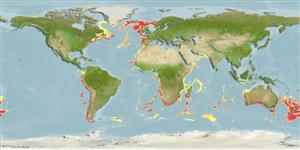
Western Atlantic: Gulf of Maine (Ref. 4784) [in error according to Moore (Fishes of the Gulf of Maine, in press), should be off northern Nova Scotia]. Eastern Atlantic: Iceland to Morocco; Walvis Bay, Namibia to off Durban, South Africa. Indo-Pacific: south-central Indian Ocean and New Zealand. Eastern Pacific: Chile (Ref. 27363). Several stocks may exist as suggested by distinct spawning sites and seasons.
प्रथम परिपक्वता पर लंबाई / आकार / वज़न / आयु
परिपक्व अवधि: Lm 34.5, range 18 - 32.5 cm
Max length : 75.0 cm TL पुल्लिंग / अलिंग; (Ref. 36696); common length : 40.0 cm TL पुल्लिंग / अलिंग; (Ref. 4181); अधिकतम प्रकाशित वज़न: 7.0 kg (Ref. 36697); अधिकतम सूचित उम्र: 149 वर्षो (Ref. 3680)
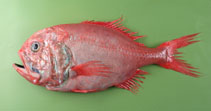
पृष्ठीय रीढ़ (सम्पूर्ण) : 4 - 6; पृष्ठीय सौफट रेज़ (सम्पूर्ण) : 15 - 19; गुदा कांटा: 3; ऐनल सौफट रेज़: 10 - 12. Bright brick-red in color, mouth and gill cavity bluish black (Ref. 4181). Ventral scutes: 19-25.
Body shape (shape guide): short and / or deep.
Inhabits deep, cold waters over steep continental slopes, ocean ridges and sea-mounts. Shallow range of usual occurrence from Ref. 27121. Appears to be dispersed over both rough bottoms and steep, rough grounds where it feeds on crustaceans and fish. In New Zealand, the main prey include mesopelagic and benthopelagic prawns, fish, and squid, with other organisms such as mysids, amphipods and euphausiids occasionally being important (Ref. 9072). Juveniles feed mainly on crustaceans (Ref. 27075, 27076). Grows very slowly and is one of the longest lived fish species known. Based on parasite and trace-element analyses, orange roughy is a sedentary species with little movement between fish-management zones (Ref. 27089). Little is known of the larvae and juveniles which are probably confined to deep water (Ref. 27088). The fishery targets sporadically formed dense spawning and non-spawning aggregations. Marketed fresh and frozen; eaten steamed, fried, microwaved and baked (Ref. 9988). Because of severe overfishing the species has been listed as threatened by the Australian Government in 2006.
Orange roughy are synchronous annual spawners (Ref. 7030). They form dense spawning aggregations over sea hills and slopes. Eggs and sperms are shed into the water at the same time. Individual males appear to spawn over a 1-2 week period and females spawn for up to 1 week. Little is known of the larvae and juveniles.
Maul, G.E., 1986. Trachichthyidae. p. 749-752. In P.J.P. Whitehead, M.-L. Bauchot, J.-C. Hureau, J. Nielsen and E. Tortonese (eds.) Fishes of the north-eastern Atlantic and the Mediterranean. UNESCO, Paris. Vol. 2. (Ref. 4784)
आईयूसीएन रेड लिस्ट स्थिति (Ref. 130435: Version 2025-2 (Global))
मनुष्यों के लिए ख़तरा
Harmless
मानव उपयोग
मात्स्यिकी: उच्च वाणिज्य
साधन
विशेष रिपोर्ट
XML डाउनलोड करें
इंटरनेट स्रोत
मॉडल पर आधारित अनुमान
पसंदीदा तापमान (संदर्भ
123201): 3.5 - 8.4, mean 6.6 °C (based on 754 cells).
जातिवृति विविधता सूचकांक (संदर्भ
82804): PD
50 = 0.5000 [Uniqueness, from 0.5 = low to 2.0 = high].
Bayesian length-weight: a=0.02239 (0.01610 - 0.03112), b=3.08 (2.99 - 3.17), in cm total length, based on LWR estimates for this species (Ref.
93245).
ट्रॉफिक स्तर (संदर्भ
69278): 4.3 ±0.1 se; based on diet studies.
लौटाव (संदर्भ
120179): बहुत नीचे, न्यूनतम जनसंख्या दुगनी समय अवलागत 14 महीने। (K=0.04-0.06; tm=5-33; tmax=140; Fec=10,000).
Prior r = 0.07, 95% CL = 0.05 - 0.11, Based on 3 full stock assessments.
मछली पकड़ने की भेद्यता (Ref.
59153): High to very high vulnerability (72 of 100).
🛈
जलवायु भेद्यता (Ref.
125649): Moderate to high vulnerability (54 of 100).
🛈
पोषक तत्व (Ref.
124155): Calcium = 12.4 [4.3, 62.9] mg/100g; Iron = 0.266 [0.095, 0.925] mg/100g; Protein = 17.5 [15.8, 19.2] %; Omega3 = 0.16 [0.05, 0.53] g/100g; Selenium = 20.4 [6.3, 69.4] μg/100g; VitaminA = 26.7 [2.7, 276.6] μg/100g; Zinc = 0.379 [0.183, 0.821] mg/100g (wet weight);