>
Syngnathiformes (Pipefishes and seahorses) >
Syngnathidae (Pipefishes and seahorses) > Syngnathinae
Etymology: Hippocampus: Greek, ippos = horse + Greek,kampe = curvature (Ref. 45335).
Eponymy: Earl Desmond Reid (1885–1960) was Assistant Curator, Division of Fishes at the Smithsonian (United States National Museum, USNM) where Isaac Ginsburg also worked. [...] (Ref. 128868), visit book page.
More on author: Ginsburg.
Ambiente: milieu / zona climática / intervalo de profundidade / gama de distribuição
Ecologia
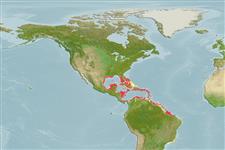
marinhas; estuarina associadas(os) a recifes; não migratória (Ref. 52884); intervalo de profundidade 0 - 60 m (Ref. 30915). Subtropical; 29°N - 25°S, 133°W - 40°W (Ref. 57010)
Western Atlantic: USA (North Carolina) to Brazil; the Caribbean Sea.
Comprimento na primeira maturidade / Tamanho / Peso / Idade
Maturidade: Lm 8.0 range ? - ? cm
Max length : 17.5 cm OT macho/indeterminado; (Ref. 30915)
Espinhos dorsais (total) : 0; Raios dorsais moles (total) : 16 - 19.
Body shape (shape guide): other; Cross section: angular.
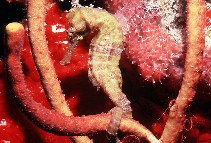
Uncommon in most areas, but may be locally common in certain places. Usually attached to gorgonians or seagrasses but may occur in floating Sargassum or swimming freely in midwater (Ref. 9710). Ovoviviparous (Ref. 205). The male carries the eggs in a brood pouch which is found under the tail (Ref. 205). Monogamous and always in home-ranging pairs, that is they do not defend an exclusive territory (Ref. 52884). Has been reared in captivity (Ref. 35409). Length type refers to Height (= from top of coronet to the tip of straightened tail). Maximum depth reported taken from Ref. 128812.
Breeding season more than 8 months in laboratory; egg diameter 1.2 mm; gestation period 2 weeks, depending on water temperature; young approximately 7 mm at birth; pair-bonded in wild (Ref. 30915). Monogamous mating is observed as both obligate and genetic (Ref. 52884).
Lourie, S.A., R.A. Pollom and S.J. Foster, 2016. A global revision of the seahorses Hippocampus Rafinesque 1810 (Actinopterygii: Syngnathiformes): taxonomy and biogeography with recommendations for further research. Zootaxa 4146(1):1-66. (Ref. 115213)
Categoria na Lista Vermelha da IUCN (Ref. 130435: Version 2025-2 (Global))
Ameaça para o homem
Harmless
Utilização humana
Pescarias: pouco comercial
Ferramentas
Relatórios especiais
Descarregue XML
Fontes da internet
Estimativas baseadas em modelos
Temperatura preferida (Ref.
123201): 24 - 28, mean 26.7 °C (based on 164 cells).
Índice de diversidade filogenética (Ref.
82804): PD
50 = 0.5000 [Uniqueness, from 0.5 = low to 2.0 = high].
Bayesian length-weight: a=0.00447 (0.00176 - 0.01132), b=3.00 (2.78 - 3.22), in cm total length, based on LWR estimates for this (Sub)family-body shape (Ref.
93245).
Nível Trófico (Ref.
69278): 3.4 ±0.4 se; based on size and trophs of closest relatives
Generation time: 1.0 ( na - na) years. Estimated as median ln(3)/K based on 2
growth studies.
Resiliência (Ref.
120179): Médio, tempo mínimo de duplicação da população 1,4 - 4,4 anos (Assuming annual Fec<1000).
Vulnerabilidade da pesca (Ref.
59153): Low vulnerability (12 of 100).
🛈
Nutrientes (Ref.
124155): Calcium = 70.1 [33.4, 185.4] mg/100g; Iron = 0.894 [0.451, 1.624] mg/100g; Protein = 18.9 [17.7, 20.1] %; Omega3 = 0.203 [0.104, 0.388] g/100g; Selenium = 18.4 [7.4, 43.5] μg/100g; VitaminA = 35.5 [9.6, 134.4] μg/100g; Zinc = 1.29 [0.78, 2.04] mg/100g (wet weight);