>
Syngnathiformes (Pipefishes and seahorses) >
Syngnathidae (Pipefishes and seahorses) > Syngnathinae
Etymology: Hippocampus: Greek, ippos = horse + Greek,kampe = curvature (Ref. 45335).
More on author: Girard.
Umwelt: Milieu / Klimazone / Tiefenbereich / Verbreitungsgebiet
Ökologie
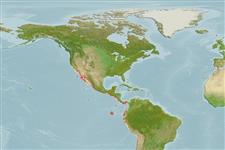
seewasser riff-verbunden; standorttreu; tiefenbereich 0 - 60 m (Ref. 30915), usually 3 - 18 m (Ref. 5227). Subtropical; 37°N - 22°S, 123°W - 70°W
Eastern Pacific: confirmed records from San Diego in California, USA to Peru including the Galapagos Islands.
Reported from the San Francisco Bay by Alexander Agassiz (Ron Fritzsche, pers.comm. 08/09).
Länge bei der ersten Reifung / Größe / Gewicht / Alter
Geschlechtsreife: Lm 5.4 range ? - ? cm
Max length : 30.0 cm TL Männchen/unbestimmt; (Ref. 2850)
Rückenflossenstacheln (insgesamt) : 0; Rückenflossenweichstrahlen (insgesamt) : 18 - 21.
Body shape (shape guide): other.
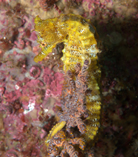
Nocturnal. Occur in offshore waters, mostly captured by dredging at 10 m or deeper. Occasionally caught at surface. Are often camouflaged within the branches of gorgonians and black coral trees where they are seen to curl their tail around the branches (Ref. 5227). Have been found in the stomachs of Pacific yellowfin tuna and bluefin tuna (Ref. 30915). Ovoviviparous (Ref. 205). The male carries the eggs in a brood pouch which is found under the tail (Ref. 205).
Male carries the eggs in a brood pouch (Ref. 205). Gestation period is 14-15 days depending on temperature (Ref. 30915).
Lourie, S.A., R.A. Pollom and S.J. Foster, 2016. A global revision of the seahorses Hippocampus Rafinesque 1810 (Actinopterygii: Syngnathiformes): taxonomy and biogeography with recommendations for further research. Zootaxa 4146(1):1-66. (Ref. 115213)
IUCN Rote Liste Status (Ref. 130435: Version 2025-2 (Global))
Bedrohung für Menschen
Harmless
Nutzung durch Menschen
Fischereien: kommerziell; Aquarium: Kommerziell
Tools
Zusatzinformationen
Download XML
Internet Quellen
Schätzungen auf der Grundlage von Modellen
Bevorzugte Temperatur (Ref.
123201): 19.1 - 28.5, mean 24.3 °C (based on 131 cells).
Phylogenetischer Diversitätsindex (Ref.
82804): PD
50 = 0.5000 [Uniqueness, from 0.5 = low to 2.0 = high].
Bayesian length-weight: a=0.00447 (0.00176 - 0.01132), b=3.00 (2.78 - 3.22), in cm total length, based on LWR estimates for this (Sub)family-body shape (Ref.
93245).
Trophische Ebene (Ref.
69278): 3.3 ±0.38 se; based on food items.
Widerstandsfähigkeit (Ref.
120179): hoch, Verdopplung der Population dauert weniger als 15 Monate. (tm=0.3-0.4).
Anfälligkeit der Fischerei (Ref.
59153): Low vulnerability (20 of 100).
🛈
Nährstoffe (Ref.
124155): Calcium = 71.1 [33.9, 167.8] mg/100g; Iron = 1.28 [0.60, 2.43] mg/100g; Protein = 18.7 [17.3, 20.0] %; Omega3 = 0.164 [0.069, 0.364] g/100g; Selenium = 32.1 [12.6, 86.2] μg/100g; VitaminA = 22.8 [5.6, 102.3] μg/100g; Zinc = 1.08 [0.61, 1.78] mg/100g (wet weight);