>
Acanthuriformes (Surgeonfishes) >
Antigoniidae (Deepbody boarfishes)
Etymology: Antigonia: Daughter of Oedipus and Jocasta, who defied her uncle, king Creon, by performing funeral rites over her brother Polynices and was condemned to be immured in a cave (Ref. 45335).
Eponymy: Lowe did not explain his reason for coining this name, but presumably it is derived from mythology as FISHBASE suggests: Antigone was the daughter of Oedipus and Jocasta, who defied her uncle, King Creon, by performing funeral rites over her brother [...] (Ref. 128868), visit book page.
More on author: Lowe.
Ambiente: milieu / zona climatica / distribuzione batimetrica / gamma di distribuzione
Ecologia
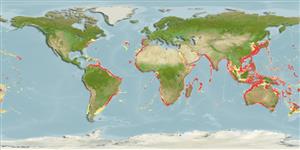
marino demersale; distribuzione batimetrica 50 - 900 m (Ref. 5217), usually 100 - 300 m (Ref. 4952). Tropical; 44°N - 51°S, 77°W - 153°W
Worldwide in subtropical and tropical oceans. Eastern Atlantic: France to Namibia, including Azores and Madeira. Western Atlantic: southern New England, USA and Gulf of Mexico to [Brazil according to Ref. 7251] Uruguay (Ref. 47377). Pacific Ocean: Hawaii (Ref. 7490), Japan (Ref. 559) and Nazca and Sala-y-Gomez (Ref. 50546).
Dimensione / Peso / Età
Maturità: Lm ? range ? - ? cm
Max length : 30.5 cm TL maschio/sesso non determinato; (Ref. 26340); common length : 15.0 cm TL maschio/sesso non determinato; (Ref. 27000); peso massimo pubblicato: 170.00 g (Ref. 5217)
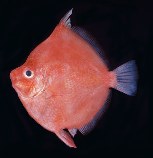
Spine dorsali (totale) : 8 - 9; Raggi dorsali molli (totale) : 33 - 37; Spine anali: 3; Raggi anali molli: 30 - 35. Body orange red, 3 dark red bands on eye, mid-body and caudal peduncle (Ref. 13608). Mouth oblique; longest dorsal spine about 1/4 of SL (Ref. 559).
Body shape (shape guide): short and / or deep; Cross section: compressed.
Adults are found close to bottom while juveniles occur in mid water (Ref. 4952). Feed on small mollusks and crustaceans (Ref. 5288). Not regularly marketed (Ref. 5217).
Ciclo vitale e comportamento di accoppiamento
Maturità | Riproduzione | Deposizione | Uova | Fecondità | Larve
Karrer, C. and A. Post, 1990. Caproidae. p. 641-642. In J.C. Quero, J.C. Hureau, C. Karrer, A. Post and L. Saldanha (eds.) Check-list of the fishes of the eastern tropical Atlantic (CLOFETA). JNICT, Lisbon; SEI, Paris; and UNESCO, Paris. Vol. 2. (Ref. 4504)
Stato della Lista Rossa IUCN (Ref. 130435: Version 2025-2 (Global))
Minaccia per l'uomo
Harmless
Usi umani
Pesca: scarso interesse commerciale
Strumenti
Rapporti speciali
Scarica XML
Fonti Internet
Stime basate su modelli
Temperatura preferita (Fonte Biblio.
123201): 10.5 - 23.6, mean 15.9 °C (based on 997 cells).
Indice di diversità filogenetica (Fonte Biblio.
82804): PD
50 = 0.5000 [Uniqueness, from 0.5 = low to 2.0 = high].
Bayesian length-weight: a=0.02570 (0.01901 - 0.03475), b=2.99 (2.90 - 3.08), in cm total length, based on LWR estimates for this species (Ref.
93245).
Livello trofico (Fonte Biblio.
69278): 4.1 ±0.0 se; based on diet studies.
Resilienza (Fonte Biblio.
120179): Medio, tempo minimo di raddoppiamento della popolazione 1.4 - 4.4 anni (Assuming tm=2-4).
Vulnerabilità della pesca (Ref.
59153): Low vulnerability (21 of 100).
🛈
Nutrienti (Ref.
124155): Calcium = 97.8 [49.0, 215.6] mg/100g; Iron = 0.856 [0.474, 1.596] mg/100g; Protein = 17.7 [16.5, 18.9] %; Omega3 = 0.241 [0.128, 0.461] g/100g; Selenium = 79.8 [35.9, 189.1] μg/100g; VitaminA = 24.1 [6.4, 103.4] μg/100g; Zinc = 0.987 [0.649, 1.481] mg/100g (wet weight);