>
Holocentriformes (Squirrelfishes, soldierfishes) >
Holocentridae (Squirrelfishes, soldierfishes) > Myripristinae
Etymology: Ostichthys: Greek,osteon = bone + Greek, ichthys = fish (Ref. 45335).
More on author: Günther.
Environnement : milieu / zone climatique / profondeur / gamme de distribution
Écologie
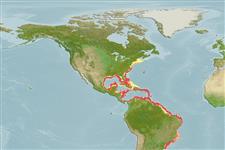
marin démersal; profondeur 37 - 550 m (Ref. 114923). Tropical; 44°N - 29°S, 98°W - 34°W
Western Atlantic: from New York south along the U.S. coast and widely in the Bahamas; including eastern Gulf of Mexico from Louisiana to the Florida Keys and northwestern Cuba. Throughout the Caribbean except the northwest quadrant in Yucatan and the Bay of Honduras and the Lesser Antilles; including south to Maceió, Alagoas State, Brazil.
Taille / Poids / Âge
Maturité: Lm ? range ? - ? cm
Max length : 20.0 cm TL mâle / non sexé; (Ref. 7251)
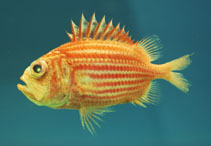
This species is distinguished by the following characters: 2½ scale rows above lateral line to midbase of spinous portion of dorsal fin; origin of anal fin is beneath spinous portion of dorsal fin; upper procurrent spiniform caudal-fin rays 4, lower rays 3; a half scale anterior to upper half of first lateral-line scale; dorsal profile of head moderately convex; pectoral-fin rays 14–16 (usually 15); lateral-line scales 28–30 (usually 29); gill rakers 8–11 + 14–17; last dorsal-fin spine is longer than penultimate spine and closely applied to soft portion of fin; snout short, 4.6–5.6 in HL; body depth 2.0–2.2 in SL; head length 2.3–2.5 in SL; least depth of caudal peduncle 4.0–4.5 in HL; colour when fresh reddish to silvery ventrally, with red stripes along the body following scale rows and usually narrower than the silvery intervening stripes; juveniles mostly silvery with red stripes limited to upper back (Ref. 114923).
Body shape (shape guide): short and / or deep; Cross section: compressed.
Cycle de vie et comportement reproducteur
Maturité | Reproduction | Frai | Œufs | Fécondité | Larves
Greenfield, D.W., J.E. Randall and P.N. Psomadakis, 2017. A review of the soldierfish genus Ostichthys (Beryciformes: Holocentridae), with descriptions of two new species in Myanmar. J. Ocean Sci. Found. 26:1-33. (Ref. 114923)
Statut dans la liste rouge de l'IUCN (Ref. 130435: Version 2025-2 (Global))
Menace pour l'homme
Harmless
Utilisations par l'homme
Outils
Articles particuliers
Télécharger en XML
Sources Internet
Estimations basées sur des modèles
Température préférée (Réf.
123201): 14.1 - 23.8, mean 19.1 °C (based on 146 cells).
Indice de diversité phylogénétique (Réf.
82804): PD
50 = 0.5000 [Uniqueness, from 0.5 = low to 2.0 = high].
Bayesian length-weight: a=0.01778 (0.00692 - 0.04567), b=3.02 (2.79 - 3.25), in cm total length, based on LWR estimates for this (Sub)family-body shape (Ref.
93245).
Niveau trophique (Réf.
69278): 3.8 ±0.6 se; based on size and trophs of closest relatives
Résilience (Réf.
120179): Haut, temps minimum de doublement de population inférieur à 15 mois (Preliminary K or Fecundity.).
Vulnérabilité de la pêche (Ref.
59153): Low vulnerability (10 of 100).
🛈