>
Atheriniformes (Silversides) >
Atherinidae (Silversides) > Atherinomorinae
Etymology: Hypoatherina: Greek, hypo = under + Greek, atherina, the Greek name for the eperlane; 1770 (Ref. 45335).
Eponymy: This is a toponym referring to Harrington Sound, Bermuda, where the type was taken. (Ref. 128868), visit book page.
More on author: Goode.
Umwelt: Milieu / Klimazone / Tiefenbereich / Verbreitungsgebiet
Ökologie
seewasser riff-verbunden. Subtropical
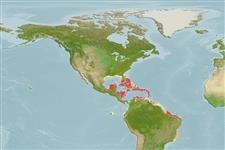
Western Atlantic: Bermuda, southern Florida (USA), and Yucatan, Mexico to northern South America. Antilles, western Caribbean (Ref. 26938). Southeast Pacific: known only from Tumaco, Colombia (Ref. 9273).
Größe / Gewicht / Alter
Geschlechtsreife: Lm ? range ? - ? cm
Max length : 10.0 cm TL Männchen/unbestimmt; (Ref. 7251); common length : 6.0 cm TL Männchen/unbestimmt; (Ref. 5217)
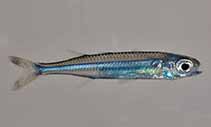
Rückenflossenstacheln (insgesamt) : 12 - 13; Rückenflossenweichstrahlen (insgesamt) : 8 - 10; Afterflossenweichstrahlen: 11 - 12. Head rather narrow, not conspicuously wider than body (Ref. 26938).
Body shape (shape guide): elongated.
Found on coral reefs. Feeds on zooplankton. Caught with dip nets, with the help of artificial lights. Occurs in large schools in shallow waters (Ref. 26938)
Lebenszyklus und Paarungsverhalten
Geschlechtsreife | Fortpflanzung | Ablaichen | Eier | Fruchtbarkeit | Larven
Oviparous, distinct pairing during breeding (Ref. 205).
Cervigón, F., R. Cipriani, W. Fischer, L. Garibaldi, M. Hendrickx, A.J. Lemus, R. Márquez, J.M. Poutiers, G. Robaina and B. Rodriguez, 1992. Fichas FAO de identificación de especies para los fines de la pesca. Guía de campo de las especies comerciales marinas y de aquas salobres de la costa septentrional de Sur América. FAO, Rome. 513 p. Preparado con el financiamento de la Comisión de Comunidades Europeas y de NORAD. (Ref. 5217)
IUCN Rote Liste Status (Ref. 130435: Version 2025-2 (Global))
Bedrohung für Menschen
Harmless
Nutzung durch Menschen
Fischereien: kommerzielles potential
Tools
Zusatzinformationen
Download XML
Internet Quellen
Schätzungen auf der Grundlage von Modellen
Bevorzugte Temperatur (Ref.
123201): 26.3 - 28.2, mean 27.4 °C (based on 664 cells).
Phylogenetischer Diversitätsindex (Ref.
82804): PD
50 = 0.5001 [Uniqueness, from 0.5 = low to 2.0 = high].
Bayesian length-weight: a=0.00575 (0.00245 - 0.01350), b=3.15 (2.95 - 3.35), in cm total length, based on LWR estimates for this (Sub)family-body shape (Ref.
93245).
Trophische Ebene (Ref.
69278): 3.0 ±0.17 se; based on food items.
Widerstandsfähigkeit (Ref.
120179): hoch, Verdopplung der Population dauert weniger als 15 Monate. (Preliminary K or Fecundity.).
Anfälligkeit der Fischerei (Ref.
59153): Low vulnerability (10 of 100).
🛈
Nährstoffe (Ref.
124155): Calcium = 85.8 [33.4, 202.4] mg/100g; Iron = 0.765 [0.377, 1.491] mg/100g; Protein = 20 [18, 22] %; Omega3 = 0.178 [0.075, 0.461] g/100g; Selenium = 7.59 [3.16, 21.15] μg/100g; VitaminA = 109 [28, 420] μg/100g; Zinc = 1.43 [0.84, 2.36] mg/100g (wet weight);