>
Atheriniformes (Silversides) >
Atherinopsidae (Neotropical silversides) > Atherinopsinae
Etymology: Atherinops: Greek, atherina, the Greek name for the eperlane; 1770 + Greek, ops = appearance (Ref. 45335); affinis: affinis which means related - in this case to fishes of the genus Atherina (Ref. 6885).
More on author: Ayres.
Entorno: milieu / zona climática / rango de profundidad / gama de distribución
Ecología
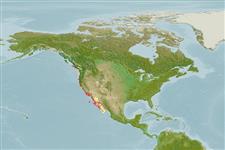
marino; salobre pelagic-neritic; rango de profundidad ? - 26 m (Ref. 96339). Subtropical; 52°N - 21°N, 130°W - 105°W (Ref. 96339)
Eastern Pacific: Vancouver Island in British Columbia, Canada to Baja California, Mexico and the Gulf of California.
Tamaño / Peso / Edad
Madurez: Lm ? range ? - ? cm
Max length : 37.0 cm TL macho / no sexado; (Ref. 9273); common length : 28.0 cm TL macho / no sexado; (Ref. 9273); edad máxima reportada: 9 años (Ref. 72477)
Descripción breve
Claves de identificación | Morfología | Morfometría
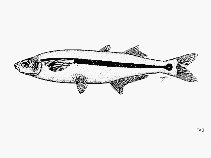
Espinas dorsales (total) : 6 - 10; Radios blandos dorsales (total) : 8 - 14; Espinas anales: 1; Radios blandos anales: 19 - 25; Vértebra: 44 - 52. Blue gray to green above, silvery below; a striking silver band bordered above with blue extends the full length of the body (Ref. 6885). Branchiostegal rays: 5-6 (Ref. 36497).
Body shape (shape guide): elongated.
Common in bays, muddy and rocky areas and kelp beds, also in estuaries (Ref. 36497). Form schools. Adults feed on zooplankton (Ref. 9273), while juveniles feed on algae and kelp fly larvae (Ref. 4930). Demersal spawner in nearshore habitats (Ref. 56049). Oviparous, with planktonic, primarily neustonic larvae (Ref. 36497). Eggs are attached to spawning substrate and to one another by adhesive filaments (Ref. 36497).
Eschmeyer, W.N., E.S. Herald and H. Hammann, 1983. A field guide to Pacific coast fishes of North America. Boston (MA, USA): Houghton Mifflin Company. xii+336 p. (Ref. 2850)
Situación en la Lista Roja de la UICN (Ref. 130435: Version 2025-2 (Global))
Amenaza para el ser humano
Harmless
Usos humanos
Pesquerías: comercial
Herramientas
Informes especiales
Descargar XML
Fuentes de Internet
Estimaciones basadas en modelos
Temperatura preferida (Referencia
123201): 12.1 - 23.2, mean 18.7 °C (based on 122 cells).
Índice de diversidad filogenética (Referencia
82804): PD
50 = 1.0000 [Uniqueness, from 0.5 = low to 2.0 = high].
Bayesian length-weight: a=0.00776 (0.00432 - 0.01396), b=3.01 (2.85 - 3.17), in cm total length, based on LWR estimates for this species & (Sub)family-body (Ref.
93245).
Nivel trófico (Referencia
69278): 2.8 ±0.28 se; based on food items.
Resiliencia (Referencia
120179): Medio, población duplicada en un tiempo mínimo de 1.4-4.4 años (tm=2; tmax=7; Fec = 1,000).
Vulnerabilidad pesquera (Ref.
59153): Low to moderate vulnerability (27 of 100).
🛈