>
Cyprinodontiformes (Rivulines, killifishes and live bearers) >
Poeciliidae (Poeciliids) > Poeciliinae
Etymology: Xiphophorus: Greek, xiphos = sword + Greek, pherein = to carry (Ref. 45335).
Eponymy: Karl Bartholomäus Heller (1824–1880) was an Austrian botanist and naturalist who explored in Mexico (1845–1848 and again in 1850) and yet again as a member of the (1864) scientific mission instituted by Napoleon III during which he mapped the state [...] (Ref. 128868), visit book page.
More on author: Heckel.
Milieu: milieu / Klimaatzone / Diepte / verspreidingsgebied
Ecologie
; zoet water; brak water benthopelagisch; pH range: 7.0 - 8.0; dH range: 9 - 19; standvastig (Ref. 126106). Tropical; 22°C - 28°C (Ref. 52054); 26°N - 12°N
North and Central America: Rio Nantla, Veracruz in Mexico to northwestern Honduras. Africa: Feral populations reported from Natal and eastern Transvaal as well as in Lake Otjikoto, Namibia (Ref. 7248). Several countries report adverse ecological impact after introduction.
Grootte / Gewicht / Leeftijd
Maturiteit: Lm ? range ? - ? cm
Max length : 14.0 cm TL mannelijk / geslacht onbekend; (Ref. 26130); 16.0 cm TL (female); common length : 2.8 cm TL mannelijk / geslacht onbekend; (Ref. 12193)
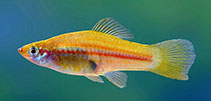
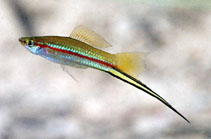
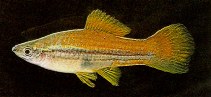
Dorsale stekels (totaal) : 0; Dorsale zachte stralen (totaal) : 11 - 14; Anale stekels: 0; Anale zachte stralen: 8 - 10. This species is distinguished by having a medium to large swordtail with a long straight caudal appendage; midlateral stripe may be dusky or brownish (northern populations) or red; 2 additional reddish stripes may be present above midlateral line and one beneath; terminal segment of gonopodial ray 3 produced into a crescent-shaped hook and blade pointed distally; ray 4a curves strongly backward over the blade at an angle greater than 90°; distal serrae of ray 4p reduced in size and number and proximal serrae rather slender; terminal segment of ray 5a produced into a claw, several times larger than the distal serrae of ray 4p (Ref. 52914).
Body shape (shape guide): fusiform / normal.
Adults are found mainly in rapidly flowing streams and rivers, preferring heavily vegetated habitats (Ref. 26130). They occur in warm springs and their effluents, weedy canals and ponds (Ref. 5723). They feed on worms, crustaceans, insects and plant matter (Ref. 7020). Used for genetics research (Ref. 4537). Especially the red varieties are very popular aquarium fishes (Ref. 1672). Aquarium keeping: the males aggressive towards each other; minimum aquarium size 80 cm (Ref. 51539).
Female produces 20 to 200 young after a gestation period of 24 to 30 days. Attains sexual maturity after eight to twelve months (Ref. 26130). This species has a tendency to undergo sex reversal (from female to male) under certain environmental conditions (Ref. 6465).
Wischnath, L., 1993. Atlas of livebearers of the world. T.F.H. Publications, Inc., United States of America. 336 p. (Ref. 26130)
Status op de Rode Lijst van het IUCN (Ref. 130435: Version 2025-2 (Global))
Gevaar voor de mens
Potential pest
Gebruik door de mens
Visserij: van groot commercieel belang; Aquarium: van groot commercieel belang
Tools
Speciale rapporten
Download XML
Internetbronnen
Schattingen op basis van modellen
Fylogenetische diversiteitsindex (Ref.
82804): PD
50 = 0.5000 [Uniqueness, from 0.5 = low to 2.0 = high].
Bayesian length-weight: a=0.01000 (0.00609 - 0.01643), b=3.06 (2.93 - 3.19), in cm total length, based on LWR estimates for this species & (Sub)family-body (Ref.
93245).
Trofisch niveau (Ref.
69278): 3.2 ±0.43 se; based on food items.
Weerstandsvermogen (Ref.
120179): Hoog, minimale populatieverdubbelingstijd minder dan 15 maanden (tm<1; Fec=20-200 * 12).
Kwetsbaarheid van de visserij (Ref.
59153): Low vulnerability (10 of 100).
🛈