Ambiente: milieu / zona climatica / distribuzione batimetrica / gamma di distribuzione
Ecologia
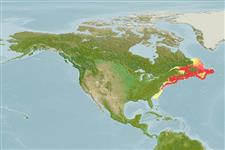
marino demersale; oceanodromo (Ref. 51243); distribuzione batimetrica 55 - 914 m (Ref. 58452). Temperate; 55°N - 24°N, 80°W - 42°W (Ref. 54581)
Northwest Atlantic: coast of Canada and USA from Bell Isle Channel to the Bahamas; most common from southern Newfoundland to South Carolina.
Lunghezza alla prima maturità / Dimensione / Peso / Età
Maturità: Lm 23.2 range ? - ? cm
Max length : 76.0 cm TL maschio/sesso non determinato; (Ref. 1371); common length : 37.0 cm TL maschio/sesso non determinato; (Ref. 1371); common length :65 cm TL (female); peso massimo pubblicato: 2.3 kg (Ref. 1371); Età massima riportata: 12 anni (Ref. 1371)
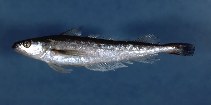
Spine dorsali (totale) : 1; Raggi dorsali molli (totale) : 47 - 54; Spine anali: 0; Raggi anali molli: 37 - 41. Head large, about 30% of SL . Pectoral fins long, reaching origin of anal fin. Overall color is silvery, somewhat brownish on back, whitish on belly.
Body shape (shape guide): elongated; Cross section: oval.
Abundant on sandy grounds and strays into shallower waters. A voracious predator with cannibalistic habits. Individuals over 40 cm TL prey on fishes such as gadoids and herring, while smaller ones feed on crustaceans, i.e. euphausiids and pandalids; food also includes gaspereau, myctophids, smelt, silversides, mackerel, sand lance, butterfish, snakeblennies, longhorn sculpins and squids (Ref. 5951). The smallest specimen feeds mostly on crustaceans (Ref. 58452). Exhibits seasonal onshore-offshore migration (Ref. 9988). Spawning takes place from June-July in the mid-Atlantic region; July-August in the Gulf of Maine and to the north of Georges Bank, and August-September on the Scotian Shelf (Ref. 58452). Marketed fresh, smoked and frozen; fresh fish are exported to European markets; eaten fried, broiled, microwaved and baked (Ref. 9988).
Spawning appears to be strongly influenced by water temperature, and annual variations occur both in the peak and the range of the spawning period, which may influence considerably the growth of juveniles.
Cohen, D.M., T. Inada, T. Iwamoto and N. Scialabba, 1990. FAO species catalogue. Vol. 10. Gadiform fishes of the world (Order Gadiformes). An annotated and illustrated catalogue of cods, hakes, grenadiers and other gadiform fishes known to date. FAO Fish. Synop. 125(10). Rome: FAO. 442 p. (Ref. 1371)
Stato della Lista Rossa IUCN (Ref. 130435: Version 2025-2 (Global))
Minaccia per l'uomo
Harmless
Usi umani
Pesca: elevato interesse commerciale; Pesce da pesca sportiva: si
Strumenti
Rapporti speciali
Scarica XML
Fonti Internet
Stime basate su modelli
Temperatura preferita (Fonte Biblio.
123201): 0.9 - 7.8, mean 4.9 °C (based on 155 cells).
Indice di diversità filogenetica (Fonte Biblio.
82804): PD
50 = 0.5000 [Uniqueness, from 0.5 = low to 2.0 = high].
Bayesian length-weight: a=0.00490 (0.00405 - 0.00592), b=3.10 (3.05 - 3.15), in cm total length, based on LWR estimates for this species (Ref.
93245).
Livello trofico (Fonte Biblio.
69278): 4.5 ±0.4 se; based on diet studies.
Generation time: 3.4 (2.7 - 4.3) years. Estimated as median ln(3)/K based on 10
growth studies.
Resilienza (Fonte Biblio.
120179): Medio, tempo minimo di raddoppiamento della popolazione 1.4 - 4.4 anni (K=0.18-0.4;tm=2-3; tmax=12).
Prior r = 0.26, 95% CL = 0.17 - 0.39, Based on 3 full stock assessments.
Vulnerabilità della pesca (Ref.
59153): Moderate to high vulnerability (54 of 100).
🛈
Vulnerabilità climatica (Ref.
125649): Moderate to high vulnerability (47 of 100).
🛈
Nutrienti (Ref.
124155): Calcium = 12.4 [6.5, 37.8] mg/100g; Iron = 0.245 [0.086, 0.595] mg/100g; Protein = 17.7 [16.6, 18.7] %; Omega3 = 0.276 [0.189, 0.400] g/100g; Selenium = 28.2 [14.6, 52.4] μg/100g; VitaminA = 17.2 [4.9, 58.6] μg/100g; Zinc = 0.279 [0.197, 0.387] mg/100g (wet weight);