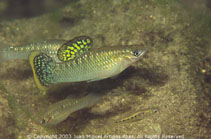
Poecilia mexicana, Shortfin molly : aquarium, bait

You can sponsor this page

Poecilia mexicana Steindachner, 1863

Shortfin molly
Hochladen Photos und videos
Bilder | Google Bild
Image of Poecilia mexicana (Shortfin molly)
Poecilia mexicana
Photo von Artigas Azas, J.M.

Klassifizierung / Names Namen | Synonyme | Catalog of Fishes(Gattung, Arten) | ITIS | CoL | WoRMS | Cloffa

> Cyprinodontiformes (Rivulines, killifishes and live bearers) > Poeciliidae (Poeciliids) > Poeciliinae
Etymology: Poecilia: Greek, poikilos = with a lot of colours (Ref. 45335).
More on author: Steindachner.

Umwelt: Milieu / Klimazone / Tiefenbereich / Verbreitungsgebiet Ökologie

; süßwasser; brackwasser benthopelagisch; pH range: 7.0 - 7.5; dH range: 20 - 30. Tropical; 22°C - 28°C (Ref. 12468); 19°N - 14°N

Verbreitung Territorien | FAO Gebiete | Ökosysteme | Vorkommen | Punkt Karte | Einführungen | Faunafri

North and Central America: Rio San Juan, Mexico to Guatemala. At least one country reports adverse ecological impact after introduction.

Größe / Gewicht / Alter

Geschlechtsreife: Lm ?  range ? - ? cm
Max length : 11.0 cm SL Männchen/unbestimmt; (Ref. 30499); common length : 4.0 cm TL Männchen/unbestimmt; (Ref. 12193)

Biologie     Fachlexikon (Englisch) (z.B. epibenthic)

Adults occur in warm springs and their effluents, canals and weedy ditches, and stream pools (Ref. 5723). Food is mainly detritus (Ref. 36880). Some populations in caves (Ref. 27297). Migratory behaviour is undetermined (Ref. 126106).

Lebenszyklus und Paarungsverhalten Geschlechtsreife | Fortpflanzung | Ablaichen | Eier | Fruchtbarkeit | Larven

28 days after fertilization female gives birth to 30-80 young. Sexual maturity is reached after 7-12 months (Ref. 2060).

Hauptreferenz Laden Sie Ihre Referenzen hoch | Referenzen | Koordinator | Partner

Proudlove, G.S., 1997. A synopsis of the hypogean fishes of the world. p. 351-354. In Proceedings of the 12th International Congress of Speleology, La Chaux de Fonds, Switzerland. vol. 3. (Ref. 27297)

IUCN Rote Liste Status (Ref. 130435: Version 2025-2 (Global))

  nicht bedroht (LC) ; Date assessed: 22 March 2018

CITES

Not Evaluated

CMS (Ref. 116361)

Not Evaluated

Bedrohung für Menschen

  Potential pest (Ref. 1982)


Nutzung durch Menschen

Fischereien: nicht kommerziell; Aquarium: Kommerziell; Köder: occasionally
FAO - Publication: search | FishSource |

Mehr Information

Trophische Ökologie
Lebensmittel (Beutetiere)
Nahrungszusammensetzung
Nahrungsaufnahme
Lebensmittelrationen
Räuber
Ökologie
Ökologie
Populationsdynamik
Wachstumsparameter
Max. Alter/Größen
Länge-Gewicht-Rel.
Länge-Länge-Verhältnis.
Längenhäufigkeiten
Massenkonvertierung
Rekrutierung
Dichte
Lebenszyklus
Fortpflanzung
Geschlechtsreife
Reifung/Kiemen rel.
Fruchtbarkeit
Ablaichen
Laichaggregationen
Eier
Eientwicklung
Larven
Larven Pop.Dyn.
Anatomie
Kiemenoberfläche
Gehirn
Otolith
Physiologie
Körperliche Zusammensetzung
Nährstoffe
Sauerstoffverbrauch
Schwimmart
Schwimmgeschwindigkeit
Visuelle Pigmente
Fischgeräusche
Krankheiten und Parasiten
Toxizität (LC50s)
Genetik
Genom
Genetik
Heterozygotie
Vererbbarkeit
Genetische Vielfalt
Menschenbezogen
Aquakultur-Systeme
Aquakultur Profile
Zuchtlinien
Ciguatera-Fälle
Briefmarken, Münzen, Verschiedenes.
Aufsuchen
Partner
Taxonomie
Namen
Synonyme
Morphologie
Morphometrie
Bilder
Referenzen
Referenzen

Tools

Zusatzinformationen

Download XML

Internet Quellen

AFORO (otoliths) | Alien/Invasive Species database | Aquatic Commons | BHL | Cloffa | Websites from users | FishWatcher Einträge suchen | CISTI | Catalog of Fishes: Gattung, Arten | DiscoverLife | ECOTOX | FAO - Publication: search | Faunafri | Fishipedia | Fishtrace | GloBI | Google Books | Google Scholar | Google | IGFA World Record | Nationale Datenbanken | OneZoom | Open Tree of Life | Otolith Atlas of Taiwan Fishes | PubMed | Reef Life Survey | Socotra Atlas | TreeBase | Tree of Life | Wikipedia: Gehe zu, Suchen | World Records Freshwater Fishing | Zoobank | Zoologischer Rekord

Schätzungen auf der Grundlage von Modellen

Phylogenetischer Diversitätsindex (Ref. 82804):  PD50 = 0.5000   [Uniqueness, from 0.5 = low to 2.0 = high].
Bayesian length-weight: a=0.01047 (0.00646 - 0.01697), b=3.11 (2.98 - 3.24), in cm total length, based on LWR estimates for this species & (Sub)family-body (Ref. 93245).
Trophische Ebene (Ref. 69278):  2.0   ±0.00 se; based on food items.
Widerstandsfähigkeit (Ref. 120179):  mittel, Verdopplung der Population dauert 1,4 - 4,4 Jahre. (Preliminary K or Fecundity.).
Anfälligkeit der Fischerei (Ref. 59153):  Low vulnerability (10 of 100). 🛈