>
Gadiformes (Cods) >
Gadidae (Cods and haddocks)
Etymology: Microgadus: Greek, mikros = samll + Latin, gadus = a fish, cod? (Ref. 45335).
More on author: Walbaum.
Environnement : milieu / zone climatique / profondeur / gamme de distribution
Écologie
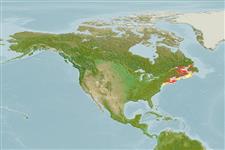
marin; eau douce; saumâtre démersal; anadrome (Ref. 26213); profondeur 0 - 69 m (Ref. 57178). Temperate; 54°N - 36°N, 76°W - 56°W (Ref. 86798)
Northwest Atlantic: southern Labrador in Canada to Virginia in USA.
Taille / Poids / Âge
Maturité: Lm ? range ? - ? cm
Max length : 38.1 cm TL mâle / non sexé; (Ref. 5951)
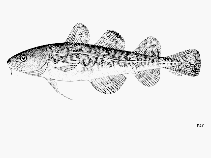
Épines dorsales (Total) : 0; Épines anales: 0. Body elongated; head small; eyes relatively small. Pelvic fins with a slightly elongated filament. Olive green brown or yellow dorsally, paler ventrally; with dark mottling on sides and fins.
Body shape (shape guide): elongated; Cross section: circular.
Adults are found in coastal, brackish and fresh water, landlocked in several lakes. They feed mostly on small crustaceans, (especially shrimps and amphipods); also worms, small mollusks, squids and fishes (smelt, sticklebacks, striped bass, alewives, shed, herring and sculpins (Ref.. 5951,1371).
Cycle de vie et comportement reproducteur
Maturité | Reproduction | Frai | Œufs | Fécondité | Larves
Oviparous, sexes are separate (Ref. 205).
Cohen, D.M., T. Inada, T. Iwamoto and N. Scialabba, 1990. FAO species catalogue. Vol. 10. Gadiform fishes of the world (Order Gadiformes). An annotated and illustrated catalogue of cods, hakes, grenadiers and other gadiform fishes known to date. FAO Fish. Synop. 125(10). Rome: FAO. 442 p. (Ref. 1371)
Statut dans la liste rouge de l'IUCN (Ref. 130435: Version 2025-2 (Global))
Menace pour l'homme
Harmless
Utilisations par l'homme
Pêcheries: intérêt commercial mineur; pêche sportive: oui
Outils
Articles particuliers
Télécharger en XML
Sources Internet
Estimations basées sur des modèles
Température préférée (Réf.
123201): 2.7 - 12.6, mean 6.4 °C (based on 144 cells).
Indice de diversité phylogénétique (Réf.
82804): PD
50 = 0.7500 [Uniqueness, from 0.5 = low to 2.0 = high].
Bayesian length-weight: a=0.00398 (0.00191 - 0.00831), b=3.13 (2.94 - 3.32), in cm total length, based on LWR estimates for this (Sub)family-body shape (Ref.
93245).
Niveau trophique (Réf.
69278): 3.8 ±0.50 se; based on food items.
Résilience (Réf.
120179): Milieu, temps minimum de doublement de population : 1,4 à 4,4 années (Assuming tm=2-4).
Vulnérabilité de la pêche (Ref.
59153): Low to moderate vulnerability (28 of 100).
🛈
Vulnérabilité climatique (Ref.
125649): High to very high vulnerability (75 of 100).
🛈
Nutriments (Ref.
124155): Calcium = 48 [26, 98] mg/100g; Iron = 0.354 [0.195, 0.622] mg/100g; Protein = 17.7 [16.4, 19.1] %; Omega3 = 0.414 [0.202, 0.847] g/100g; Selenium = 11.7 [5.8, 26.8] μg/100g; VitaminA = 13.4 [3.7, 47.0] μg/100g; Zinc = 0.656 [0.458, 0.956] mg/100g (wet weight);