>
Gadiformes (Cods) >
Gadidae (Cods and haddocks)
Etymology: Eleginus: Greek, eleginos, -ou = a fish of the Nile (Ref. 45335).
More on author: Walbaum.
Miljö: miljö / Klimatzon / djupintervall / distributionsområde
Ekologi
marina; sötvatten; brackvatten bottenlevande; amfidrom; djupintervall 10 - ? m (Ref. 1371). Polar; 74°N - 62°N, 33°E - 83°E (Ref. 1371)
Arctic: White, Barents and Kara seas and from the Kola Bay to the Ob inlet.
Storlek / Vikt / Ålder
Könsmognad: Lm ? range ? - ? cm
Max length : 42.0 cm TL hane/ej könsbestämd; (Ref. 1371); rapporterad maxålder: 12 år (Ref. 72462)
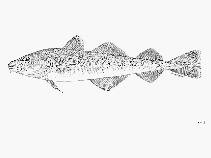
Taggstrålar i ryggfenan (totalt) : 0; Taggstrålar i analfenan: 0. Lateral line continuous to about the origin of the second dorsal fin. Head with no lateral line pores. Expanded parapophyses swollen and hollow, beginning on about vertebral centrum 5, containing outpouchings of the swim bladder. Brownish dorsally, becoming paler ventrally; with small dark blotches.
Body shape (shape guide): fusiform / normal; Cross section: oval.
Lives in the coastal sublittoral zone of the White Sea and Arctic coasts of Europe where it reflects a broad adaptation to the ecological conditions of the Arctic (Ref. 1371). Found at shallow depths, along shores with soft, muddy bottoms, close to the ice and on the continental shelf (Ref. 1371). Often caught in greatly freshened and at times completely fresh water, entering mouths and tidal zones of rivers and traveling upstream (Ref. 1371). Feeds mainly on crustaceans and worms, but takes small fishes (Ref. 1371). Taxonomic problems to be solved.
Females produce about 6,000-90,000 eggs per year. From the shores, enters river mouths over sandy or rocky bottoms for spawning. Spawning sites are distributed in channels between islands or in depressions between the shore and shallow banks with strong tidal currents.
Cohen, D.M., T. Inada, T. Iwamoto and N. Scialabba, 1990. FAO species catalogue. Vol. 10. Gadiform fishes of the world (Order Gadiformes). An annotated and illustrated catalogue of cods, hakes, grenadiers and other gadiform fishes known to date. FAO Fish. Synop. 125(10). Rome: FAO. 442 p. (Ref. 1371)
Status på IUCN:s rödlista (Ref. 130435: Version 2025-2 (Global))
Hot mot människor
Harmless
Mänskliga användningsområden
Fiskeri: kommersiell
Verktyg
Särskilda rapporter
Ladda ner XML
Internet-källor
Uppskattningar baserade på modeller
Önskad temperatur (Ref.
123201): -1.2 - 2, mean 0 °C (based on 80 cells).
Index för fylogenetisk mångfald (Ref.
82804): PD
50 = 0.7500 [Uniqueness, from 0.5 = low to 2.0 = high].
Bayesian length-weight: a=0.00676 (0.00425 - 0.01076), b=3.08 (2.94 - 3.22), in cm total length, based on LWR estimates for this species & (Sub)family-body (Ref.
93245).
Trofisk nivå (Ref.
69278): 4.2 ±0.73 se; based on food items.
Resiliens (Ref.
120179): Mellan, lägsta populationsfördubblingstid 1,4-4,4 år (tm=3-4; Fec=20,000).
Sårbarhet i fisket (Ref.
59153): Low to moderate vulnerability (32 of 100).
🛈
Sårbarhet för klimatet (Ref.
125649): High to very high vulnerability (68 of 100).
🛈
Näringsämnen (Ref.
124155): Calcium = 26.5 [13.8, 73.2] mg/100g; Iron = 0.464 [0.230, 0.997] mg/100g; Protein = 17.4 [16.0, 18.9] %; Omega3 = 0.397 [0.193, 0.852] g/100g; Selenium = 12.7 [4.9, 28.1] μg/100g; VitaminA = 19.1 [3.5, 101.3] μg/100g; Zinc = 0.435 [0.276, 0.672] mg/100g (wet weight);