>
Gadiformes (Cods) >
Phycidae (Phycid hakes)
Etymology: Urophycis: Greek, oura = tail + Greek, phyke, pykis, -idos = the female of a fish that lives among algae (Greek = phykon), related with the gudgeon (Ref. 45335).
More on author: Mitchill.
Umwelt: Milieu / Klimazone / Tiefenbereich / Verbreitungsgebiet
Ökologie
seewasser demersal; ozeanodrom (Ref. 51243); tiefenbereich 100 - 1000 m (Ref. 5951), usually 100 - 247 m (Ref. 1371). Temperate; 66°N - 27°N, 81°W - 13°W
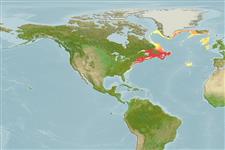
Western Atlantic: Labrador and the Grand Banks of Newfoundland to the coast of North Carolina. Straying to Iceland in the east and Florida in the south.
Länge bei der ersten Reifung / Größe / Gewicht / Alter
Geschlechtsreife: Lm 46.0, range 48 - ? cm
Max length : 133 cm TL Männchen/unbestimmt; (Ref. 40637); 135.0 cm TL (female); common length : 70.0 cm TL Männchen/unbestimmt; (Ref. 1371); max. veröff. Gewicht: 21.0 kg (Ref. 4699); max. veröff. Alter: 23 Jahre (Ref. 796)
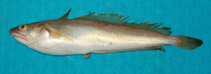
Rückenflossenstacheln (insgesamt) : 0; Afterflossenstacheln: 0. Upper limb or first gill arch with 2 (rarely 3) rakers. First dorsal in with an elongated ray. Body color variable, dorsally various dark shades, paler laterally, sometimes bronze, belly pale dirty to yellow white; pelvic fin pale. A dusky blotch present on the opercle.
Body shape (shape guide): fusiform / normal; Cross section: circular.
Found on soft, muddy bottoms of the continental shelf and upper slope. It is mostly found at 180 m. Mature fish migrate inshore in the northern Gulf of Maine in summer, disperse in autumn, and move into deepest areas in winter. Feed on small crustaceans, squids and small fish. Utilized fresh, smoked or frozen; eaten steamed, microwaved and baked (Ref. 9988). Exported to Europe (Ref. 9988).
Cohen, D.M., T. Inada, T. Iwamoto and N. Scialabba, 1990. FAO species catalogue. Vol. 10. Gadiform fishes of the world (Order Gadiformes). An annotated and illustrated catalogue of cods, hakes, grenadiers and other gadiform fishes known to date. FAO Fish. Synop. 125(10). Rome: FAO. 442 p. (Ref. 1371)
IUCN Rote Liste Status (Ref. 130435: Version 2025-2 (Global))
Bedrohung für Menschen
Harmless
Nutzung durch Menschen
Fischereien: hoch kommerziell; Sportfisch: ja
Tools
Zusatzinformationen
Download XML
Internet Quellen
Schätzungen auf der Grundlage von Modellen
Bevorzugte Temperatur (Ref.
123201): 1.2 - 7.8, mean 4.8 °C (based on 160 cells).
Phylogenetischer Diversitätsindex (Ref.
82804): PD
50 = 0.5044 [Uniqueness, from 0.5 = low to 2.0 = high].
Bayesian length-weight: a=0.00398 (0.00337 - 0.00471), b=3.16 (3.11 - 3.21), in cm total length, based on LWR estimates for this species (Ref.
93245).
Trophische Ebene (Ref.
69278): 4.3 ±0.5 se; based on diet studies.
Generation time: 10.4 ( na - na) years. Estimated as median ln(3)/K based on 2
growth studies.
Widerstandsfähigkeit (Ref.
120179): niedrig, Verdopplung der Population dauert 4,5 - 14 Jahre. (K=0.11; tm=2; tmax=23; Fec=1 million).
Prior r = 0.40, 95% CL = 0.26 - 0.59, Based on 3 full stock assessments.
Anfälligkeit der Fischerei (Ref.
59153): High to very high vulnerability (72 of 100).
🛈
Klimaanfälligkeit (Ref.
125649): Moderate to high vulnerability (53 of 100).
🛈
Nährstoffe (Ref.
124155): Calcium = 15.8 [9.1, 31.6] mg/100g; Iron = 0.316 [0.184, 0.544] mg/100g; Protein = 18.1 [16.8, 19.4] %; Omega3 = 0.602 [0.318, 1.095] g/100g; Selenium = 25.5 [14.3, 49.2] μg/100g; VitaminA = 12.8 [3.9, 41.9] μg/100g; Zinc = 0.325 [0.235, 0.457] mg/100g (wet weight);