>
Gadiformes (Cods) >
Gadidae (Cods and haddocks)
Etymology: Micromesistius: Greek, mikros = small + greek, mesos = middle + Greek, istion = sail (Ref. 45335).
More on author: Risso.
Ambiente: milieu / zona climática / intervalo de profundidade / gama de distribuição
Ecologia
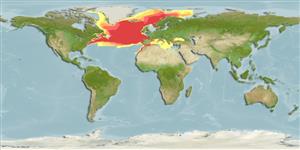
marinhas batipelágico; oceanódromo (Ref. 51243); intervalo de profundidade 150 - 3000 m (Ref. 3663), usually 300 - 400 m. Temperate; 79°N - 26°N, 82°W - 51°E (Ref. 1371)
Northeast Atlantic: Barents Sea south through the eastern Norwegian Sea, around Iceland, then in the western Mediterranean, and south along the African coast to Cape Bojador. Northwest Atlantic: southern Greenland and off southeast Canada and the northeastern coast of the USA.
Comprimento na primeira maturidade / Tamanho / Peso / Idade
Maturidade: Lm 15.0 range ? - ? cm
Max length : 55.5 cm TL macho/indeterminado; (Ref. 106276); common length : 22.0 cm TL macho/indeterminado; (Ref. 1371); peso máx. Publicado: 830.00 g (Ref. 40637); Idade máx. registada: 20 anos (Ref. 1371)
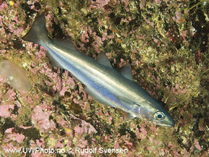
Espinhos dorsais (total) : 0; Raios dorsais moles (total) : 24 - 28; Raios anais moles: 33 - 39. Dorsal fins widely spaced, interspace between second and third fins longer than base length of first dorsal fin. Lateral line continuous over whole body. Color is blue-gray dorsally, grading to white ventrally. Sometimes with a small black blotch at the base of the pectoral fin.
Body shape (shape guide): elongated; Cross section: circular.
Found over the continental slope and shelf to more than 1000 m, but more common at 300-400 m. Feeds mostly on small crustaceans but large individuals also prey on small fish and cephalopods. Makes daily vertical migrations: surface waters at night and near the bottom during the day. Sold fresh and frozen, and also processed as oil and fishmeal (Ref. 1371).
Oviparous and gonochorous (Ref. 205).
Cohen, D.M., T. Inada, T. Iwamoto and N. Scialabba, 1990. FAO species catalogue. Vol. 10. Gadiform fishes of the world (Order Gadiformes). An annotated and illustrated catalogue of cods, hakes, grenadiers and other gadiform fishes known to date. FAO Fish. Synop. 125(10). Rome: FAO. 442 p. (Ref. 1371)
Categoria na Lista Vermelha da IUCN (Ref. 130435: Version 2025-2 (Global))
Ameaça para o homem
Harmless
Utilização humana
Pescarias: altamente comercial
Ferramentas
Relatórios especiais
Descarregue XML
Fontes da internet
Estimativas baseadas em modelos
Temperatura preferida (Ref.
123201): 3.1 - 13.9, mean 7 °C (based on 157 cells).
Índice de diversidade filogenética (Ref.
82804): PD
50 = 0.7500 [Uniqueness, from 0.5 = low to 2.0 = high].
Bayesian length-weight: a=0.00417 (0.00344 - 0.00505), b=3.12 (3.06 - 3.18), in cm total length, based on LWR estimates for this species (Ref.
93245).
Nível Trófico (Ref.
69278): 4.1 ±0.3 se; based on diet studies.
Generation time: 4.8 (3.1 - 5.0) years. Estimated as median ln(3)/K based on 15
growth studies.
Resiliência (Ref.
120179): Médio, tempo mínimo de duplicação da população 1,4 - 4,4 anos (K=0.18-0.22; tm=1-5; tmax=20; Fec=6000).
Prior r = 0.47, 95% CL = 0.31 - 0.70, Based on 9 full stock assessments.
Vulnerabilidade da pesca (Ref.
59153): Low to moderate vulnerability (32 of 100).
🛈
Vulnerabilidade climática (Ref.
125649): Low vulnerability (18 of 100).
🛈
Nutrientes (Ref.
124155): Calcium = 59.8 [18.9, 176.3] mg/100g; Iron = 0.423 [0.151, 1.166] mg/100g; Protein = 17.6 [15.2, 20.1] %; Omega3 = 0.249 [0.113, 0.554] g/100g; Selenium = 8.99 [2.88, 24.62] μg/100g; VitaminA = 33.2 [3.4, 311.2] μg/100g; Zinc = 0.712 [0.380, 1.580] mg/100g (wet weight); based on
nutrient studies.