Umwelt: Milieu / Klimazone / Tiefenbereich / Verbreitungsgebiet
Ökologie
seewasser riff-verbunden; tiefenbereich 0 - 66 m (Ref. 9710). Subtropical; 19°N - 1°S, 89°W - 48°W (Ref. 55171)
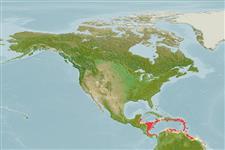
Western Atlantic: Bermuda, Florida Keys (USA), Gulf of Mexico, Bahamas; Greater Antilles (including Cuba, Hispanola, Puerto Rico, Jamaica and Cayman Is.), Virgin Is.; Lesser Antilles (island chain south of the British Virgin Islands to Grenada); western Caribbean (ne tip of the Yucatan Peninsula to Colombia, including offshore islands; northern South America (region north of Amazon River including Trinidad and Tobago and off coasts of Colombia, Venezuela. Eastern Atlantic: Ascension Island.
Größe / Gewicht / Alter
Geschlechtsreife: Lm ? range ? - ? cm
Max length : 20.0 cm TL Männchen/unbestimmt; (Ref. 7251)
Rückenflossenweichstrahlen (insgesamt) : 11 - 12; Afterflossenweichstrahlen: 6 - 7. Illicium about twice as long as second dorsal spine (Ref. 26938).
Body shape (shape guide): short and / or deep.
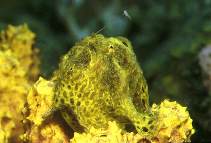
Inhabit shallow reefs (Ref. 9710). Commonly found in areas with sponges; background hue of the fish conforms to that of the dominant sponge in the areas and the ocelli look like openings in the sponge. Feed mainly on fishes, but also eat crustaceans (Ref. 13442). A voracious predator, with many color phases used for camouflage. Oviparous (Ref. 205). Eggs are bound in ribbon-like sheath or mass of gelatinous mucus called 'egg raft' or 'veil' (Ref. 6773). Most common frogfish in the West Indies (Ref. 26938).
Lebenszyklus und Paarungsverhalten
Geschlechtsreife | Fortpflanzung | Ablaichen | Eier | Fruchtbarkeit | Larven
Oviparous.
Robins, C.R. and G.C. Ray, 1986. A field guide to Atlantic coast fishes of North America. Houghton Mifflin Company, Boston, U.S.A. 354 p. (Ref. 7251)
IUCN Rote Liste Status (Ref. 130435: Version 2025-2 (Global))
Bedrohung für Menschen
Harmless
Nutzung durch Menschen
Fischereien: kleinfischerei; Aquarium: Kommerziell
Tools
Zusatzinformationen
Download XML
Internet Quellen
Schätzungen auf der Grundlage von Modellen
Bevorzugte Temperatur (Ref.
123201): 27.1 - 28.3, mean 27.8 °C (based on 78 cells).
Phylogenetischer Diversitätsindex (Ref.
82804): PD
50 = 0.5002 [Uniqueness, from 0.5 = low to 2.0 = high].
Bayesian length-weight: a=0.02692 (0.01067 - 0.06789), b=2.96 (2.73 - 3.19), in cm total length, based on LWR estimates for this (Sub)family-body shape (Ref.
93245).
Trophische Ebene (Ref.
69278): 4.3 ±0.7 se; based on diet studies.
Widerstandsfähigkeit (Ref.
120179): hoch, Verdopplung der Population dauert weniger als 15 Monate. (Fec assumed to be > 10,000).
Anfälligkeit der Fischerei (Ref.
59153): Low vulnerability (10 of 100).
🛈
Nährstoffe (Ref.
124155): Calcium = 33.2 [14.6, 80.1] mg/100g; Iron = 0.619 [0.309, 1.196] mg/100g; Protein = 19.5 [17.0, 22.7] %; Omega3 = 0.182 [0.066, 0.484] g/100g; Selenium = 12.3 [4.9, 32.9] μg/100g; VitaminA = 114 [27, 508] μg/100g; Zinc = 0.686 [0.399, 1.116] mg/100g (wet weight);