>
Gadiformes (Cods) >
Gadidae (Cods and haddocks)
Etymology: Gadus: Latin, gadus = a fish, cod? (Ref. 45335); macrocephalus: macrocephalus meaning large head (Ref. 6885).
Ambiente: milieu / zona climatica / distribuzione batimetrica / gamma di distribuzione
Ecologia
marino; salmastro demersale; oceanodromo (Ref. 138310); distribuzione batimetrica 10 - 1280 m (Ref. 50550), usually 100 - 400 m (Ref. 54440). Boreal; 6°C - 9°C (Ref. 11800); 63°N - 31°N, 119°E - 119°W (Ref. 54440)
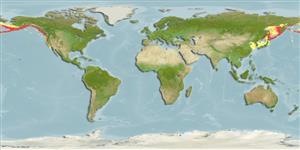
Arctic: Chukchi and Beaufort Seas eastward across Arctic Canada to western Greenland; south in the Atlantic Ocean to Gulf of St. Lawrence. Pacific Ocean: eastern Pacific to southern California at Santa Monica, and in the western Pacific to the Yellow Sea.
Lunghezza alla prima maturità / Dimensione / Peso / Età
Maturità: Lm 66.6, range 23 - 85 cm
Max length : 119 cm TL maschio/sesso non determinato; (Ref. 40637); peso massimo pubblicato: 22.7 kg (Ref. 27436); Età massima riportata: 25 anni (Ref. 55701)
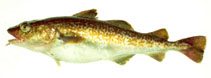
Spine dorsali (totale) : 0; Raggi dorsali molli (totale) : 37 - 57; Spine anali: 0; Raggi anali molli: 31 - 42; Vertebre: 49 - 55. Distinguished by the presence of 3 dorsal and 2 anal fins, a long chin barbel (about 3/4 as long as the eye diameter in young, longer than eye diameter in adults), and a space between the second and third dorsal fins that is shorter than the eye diameter (Ref. 27547). Lateral line with a prominent arch under the 1st and 2nd dorsal fins, is straight toward the tail, ending under the 3rd dorsal (Ref. 27547). Brown or gray dorsally, becoming paler ventrally; dark spots or vermiculating patterns on the sides (Ref.1371). Yellow color phases are known (Ref. 27547). Fins dusky; dorsal, anal and caudal fins with white edges that are wider on anal and caudal than on dorsal (Ref. 27547).
Body shape (shape guide): fusiform / normal; Cross section: oval.
Found mainly along the continental shelf and upper slopes (Ref. 1371). Form schools (Ref. 9988). They appear to be indiscriminate predators upon dominant food organisms present (Ref. 1371). Young probably feed on copepods and similar organisms (Ref. 27547). Adults feed on fishes, octopi, and large benthic and benthopelagic crustaceans (Ref. 1371); also worms. Parasites of the species include sealworm (Phocanema decipiens) in flesh, copepod (Lernaeocera branchialis) on gills and cestode (Pyramicocephalus phocarum) in the intestine (Ref. 5951). Marketed fresh and frozen for human consumption (Ref. 2850), and also dried or salted and smoked (Ref. 9988). Eaten steamed, fried, broiled, boiled, micro-waved and baked (Ref. 9988). Used in Chinese medicine (Ref. 12166). Minimum depth from Ref. 054440.
From late summer to mid-winter, fish move into the deeper water (100 to 250 m) of spawning areas; move inshore to depths of 30 to 60 m after spawning (Ref. 27547). Spawning occurs once a year (Ref. 120291).
Cohen, D.M., T. Inada, T. Iwamoto and N. Scialabba, 1990. FAO species catalogue. Vol. 10. Gadiform fishes of the world (Order Gadiformes). An annotated and illustrated catalogue of cods, hakes, grenadiers and other gadiform fishes known to date. FAO Fish. Synop. 125(10). Rome: FAO. 442 p. (Ref. 1371)
Stato della Lista Rossa IUCN (Ref. 130435: Version 2025-2 (Global))
Minaccia per l'uomo
Harmless
Usi umani
Pesca: elevato interesse commerciale; Pesce da pesca sportiva: si
Strumenti
Rapporti speciali
Scarica XML
Fonti Internet
Stime basate su modelli
Temperatura preferita (Fonte Biblio.
123201): 0.5 - 6.4, mean 2.9 °C (based on 495 cells).
Indice di diversità filogenetica (Fonte Biblio.
82804): PD
50 = 0.5625 [Uniqueness, from 0.5 = low to 2.0 = high].
Bayesian length-weight: a=0.00724 (0.00626 - 0.00838), b=3.10 (3.06 - 3.14), in cm total length, based on LWR estimates for this species (Ref.
93245).
Livello trofico (Fonte Biblio.
69278): 4.2 ±0.1 se; based on diet studies.
Resilienza (Fonte Biblio.
120179): Basso, tempo minimo di raddoppiamento della popolazione 4.5 - 14 anni (Musick et al. 2000 (Ref.
36717); tmax=25; tm=3-8; K=0.11-0.27; Fec >1million).
Prior r = 0.35, 95% CL = 0.23 - 0.53, Based on 13 full stock assessments.
Vulnerabilità della pesca (Ref.
59153): Moderate to high vulnerability (50 of 100).
🛈
Vulnerabilità climatica (Ref.
125649): Moderate to high vulnerability (45 of 100).
🛈
Nutrienti (Ref.
124155): Calcium = 13.9 [9.0, 26.2] mg/100g; Iron = 0.194 [0.130, 0.305] mg/100g; Protein = 17.6 [16.1, 19.0] %; Omega3 = 0.377 [0.161, 0.932] g/100g; Selenium = 14.1 [4.9, 39.4] μg/100g; VitaminA = 4.51 [0.66, 26.54] μg/100g; Zinc = 0.353 [0.271, 0.433] mg/100g (wet weight); based on
nutrient studies.