>
Percopsiformes (Trout-perches, pirate perches and cavefishes) >
Amblyopsidae (Cavefishes)
Etymology: Amblyopsis: Greek, amblys = darkness + Greek, ops = shape (Ref. 45335).
Eponymy: Rosa Smith Eigenmann (1858–1947) was the wife of ichthyologist Carl H Eigenmann and an ichthyologist in her own right. [...] (Ref. 128868), visit book page.
More on author: Eigenmann.
Environnement : milieu / zone climatique / profondeur / gamme de distribution
Écologie
; eau douce démersal; non migrateur (Ref. 126106). Temperate; 38°N - 35°N
North America: Springfield Plateau in southwestern Missouri, northeastern Oklahoma and northwestern Arkansas (Arkansas and upper White River drainages), USA.
Taille / Poids / Âge
Maturité: Lm ? range ? - ? cm
Max length : 6.2 cm TL mâle / non sexé; (Ref. 5723); common length : 4.4 cm TL mâle / non sexé; (Ref. 12193)
Description synthétique
Clés d'identification | Morphologie | Morphométrie
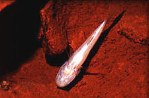
Rayons mous dorsaux (Total) : 7 - 8; Rayons mous anaux: 8. Pink-white. No eyes (vestigial eye tissues under skin). No pelvic fins. Usually 8 anal rays; 9-11 branched caudal rays.
Body shape (shape guide): elongated.
Adults inhabit subterranean waters of quite small cave streams. Preferred habitat in these caves is chert rubble though individuals are also found in areas of silt-sand substrates. Stomachs examined contained copepods which constituted about 70-90% by volume with the balance being primarily small salamanders, crayfish, isopods, amphipods and young of their own species (Ref. 34868). Eggs are carried in gill chambers of females (Ref. 205). Threatened by overfishing (Ref. 10172).
Cycle de vie et comportement reproducteur
Maturité | Reproduction | Frai | Œufs | Fécondité | Larves
Incubates eggs in gill chamber of females (Ref. 205).
Page, L.M. and B.M. Burr, 1991. A field guide to freshwater fishes of North America north of Mexico. Houghton Mifflin Company, Boston. 432 p. (Ref. 5723)
Statut dans la liste rouge de l'IUCN (Ref. 130435: Version 2025-2 (Global))
Menace pour l'homme
Harmless
Utilisations par l'homme
Pêcheries: sans intérêt
Outils
Articles particuliers
Télécharger en XML
Sources Internet
Estimations basées sur des modèles
Indice de diversité phylogénétique (Réf.
82804): PD
50 = 0.6331 [Uniqueness, from 0.5 = low to 2.0 = high].
Bayesian length-weight: a=0.00389 (0.00180 - 0.00842), b=3.12 (2.94 - 3.30), in cm total length, based on all LWR estimates for this body shape (Ref.
93245).
Niveau trophique (Réf.
69278): 3.5 ±0.54 se; based on food items.
Résilience (Réf.
120179): Faible, temps minimum de doublement de population : 4,5 à 14 années (K=0.3; Fec=25).
Vulnérabilité de la pêche (Ref.
59153): Low vulnerability (10 of 100).
🛈