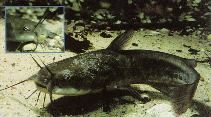
分類 / 名稱
俗名 | 同種異名 | Catalog of Fishes(屬, 種) | ITIS | CoL | WoRMS | Cloffa
Teleostei >
Siluriformes (Catfishes)
鯰形目 (Catfishes) >
Ictaluridae (North American freshwater catfishes)
鮰科 (North American freshwater catfishes)
Etymology: Ameiurus: Greek, a = without + Greek, meiouros, -os, -on = without tail (Ref. 45335); nebulosus: nebulosus meaning clouded, in relation to mottled and grey coloring (Ref. 1998).
More on author: Lesueur.
環境: 環境 / 氣候帶 / 深度上下限 / 配送範圍
生態學
; 淡水 居於水底的; 河川洄游 (Ref. 126106); 深度上下限 0 - 12 m (Ref. 1998). 溫帶; 0°C - 37°C (Ref. 35682); 54°N - 25°N, 104°W - 61°W (Ref. 86798)
North America: Atlantic and Gulf Slope drainages from Nova Scotia and New Brunswick in Canada to Mobile Bay in Alabama in USA; St. Lawrence-Great Lakes, Hudson Bay, and Mississippi River basins from Quebec west to southeastern Saskatchewan in Canada, and south to Louisiana, USA. Introduced into several countries. Several countries report adverse ecological impact after introduction.
北美洲: 到在美國, 與聖勞倫斯河-五大湖區中的在阿拉巴馬州的摩比灣的大西洋斜坡與海灣斜坡流域從新斯科舍省與加拿大的新布蘭斯維克來自魁北克的哈得遜灣與密西西比河流域西至加拿大的薩斯卡萬而且南至美國路易斯安那州。 引入一些國家中了。 引入後的一些國家報告不利的生態衝擊。 亞洲: 伊朗與土耳其.(參考文獻 39702)
初熟時的長度 / 大小 / 重量 / 年齡
成熟度: Lm 26.6, range 20 - 33 cm
Max length : 55.0 cm TL 雄魚/尚未辨別雌雄; (Ref. 40637); common length : 25.0 cm TL 雄魚/尚未辨別雌雄; (Ref. 556); 最大體重: 2.7 kg (Ref. 40637); 最大年齡: 9 年 (Ref. 59043)
背棘 (總數) : 1; 背的軟條 (總數) : 6 - 7; 臀棘: 1. Caudal fin with 18-19 rays.
Body shape (shape guide): fusiform / normal.
尾鰭有 18-19個鰭條。
Adults occur in pools and sluggish runs over soft substrates in creeks and small to large rivers. Also found in impoundments, lakes, and ponds (Ref. 86798). They rarely enter brackish waters (Ref. 1998). They are nocturnal feeders that feed on mollusks, insects, leeches, crayfish and plankton, worms, algae, plant material, fishes, eggs of least cisco, herring and lake trout (Ref. 1998). Juveniles (3-6 cm) feed mostly on chironomid larvae, cladocerans, ostracods, amphipods, bugs and mayflies (Ref. 1998). Can tolerate high carbon dioxide and low oxygen concentrations and temperatures up to 31.6 °C although experiments show upper lethal temp. to be 37.5 °C; resistant to domestic and industrial pollution (Ref. 1998). They have been observed to bury itself in mud to escape adverse environmental conditions (Ref. 1998). Prepared hot-smoked and also cooked in various ways (Ref. 1998).
在小溪與小型到大型河川中出現於在軟的底部上的水潭與滯流的小支流。 也發現於圈圍水域,湖與池塘。 很少進入半鹹淡水域。 (參考文獻 1998) 吃軟體動物,昆蟲,水蛭, 小龍蝦與浮游生物,蠕蟲,藻類,植物的一個夜行的捕食者 , 魚而且已經被報告覓食最少的魚曹白魚之類,鯡魚與鱒魚的卵.(參考文獻 1998) 稚魚 (3-6 公分) 大部分吃寶刀魚仔魚,水蚤,介形蟲,片腳類動物,蟲與孚游類。 (參考文獻 1998) 雖然實驗顯示致命溫度上限是 37.5 °C ,能容忍高二氧化碳與溶氧量低的集中與溫度高達 31.6 °C; 有抵抗性到家庭的與工業污染.(參考文獻 1998) 曾經觀察埋頭於泥到逃脫不利的環境狀況.(參考文獻 1998) 在各種不同的方面以煙燻調理以及煮了或熱煙燻的.(參考文獻 1998)
生命週期和交配行為
成熟度 | 繁殖 | 產卵場 | 卵 | 孕卵數 | 仔魚
Nests are built by one or both sexes. After a period of caressing each other with their barbels, male and female settle over the nest, face opposite directions (while maintaining body contact) and spawn. Although eggs are cared for by one or both parents, there have been reports of parents eating their own eggs. Caring entails fanning by the paired fins, moving and stirring by the barbels, and may be picked up and ejected from the mouth; this ensures hatching.北美洲: 到在美國, 與聖勞倫斯河-五大湖區中的在阿拉巴馬州的摩比灣的大西洋斜坡與海灣斜坡流域從新斯科舍省與加拿大的新布蘭斯維克來自魁北克的哈得遜灣與密西西比河流域西至加拿大的薩斯卡萬而且南至美國路易斯安那州。 引入一些國家中了。 引入後的一些國家報告不利的生態衝擊。 亞洲: 伊朗與土耳其.(參考文獻 39702)
Page, L.M. and B.M. Burr, 2011. A field guide to freshwater fishes of North America north of Mexico. Boston : Houghton Mifflin Harcourt, 663p. (Ref. 86798)
IUCN 瀕危狀態 (Ref. 130435: Version 2025-2 (Global))
無危 (LC) ; Date assessed: 14 October 2011
人類使用
漁業: 低經濟; 養殖: 商業性; 游釣魚種: 是的
工具
特別的報告
下載 XML
網路資源
基於模型的估計
系統發育多樣性指數 (參考文獻
82804): PD
50 = 0.5078 [Uniqueness, from 0.5 = low to 2.0 = high].
Bayesian length-weight: a=0.00832 (0.00640 - 0.01081), b=3.12 (3.04 - 3.20), in cm total length, based on LWR estimates for this species (Ref.
93245).
營養階層 (參考文獻
69278): 3.7 ±0.1 se; based on diet studies.
回復力 (參考文獻
120179): 中等的, 族群倍增時間最少 1.4 - 4.4年 (K=0.47; tm=3; tmax=8).
釣魚的脆弱性 (Ref.
59153): Moderate vulnerability (38 of 100).
🛈