>
Anguilliformes (Eels and morays) >
Anguillidae (Freshwater eels)
Etymology: Anguilla: Latin, anguilla, .-ae = eel (Ref. 45335); rostrata: From the words Anguilla-Latin for eel and rostrata, meaning long nose (Ref. 10294).
More on author: Lesueur.
Umwelt: Milieu / Klimazone / Tiefenbereich / Verbreitungsgebiet
Ökologie
seewasser; süßwasser; brackwasser demersal; katadrom (Ref. 26938); tiefenbereich 0 - 464 m (Ref. 57178). Subtropical; 4°C - 25°C (Ref. 12468); 66°N - 5°N, 98°W - 21°W
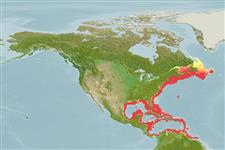
Northwest to western Central Atlantic: Greenland south along the Atlantic coast of Canada and the USA to Panama, and throughout much of the West Indies south to Trinidad.
Länge bei der ersten Reifung / Größe / Gewicht / Alter
Geschlechtsreife: Lm 68.5, range 37 - 100 cm
Max length : 152 cm TL Männchen/unbestimmt; (Ref. 26938); 122.0 cm TL (female); common length : 50.0 cm TL Männchen/unbestimmt; (Ref. 3242); max. veröff. Gewicht: 7.3 kg (Ref. 4699); max. veröff. Alter: 43 Jahre (Ref. 40922)
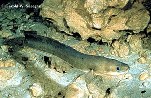
Rückenflossenstacheln (insgesamt) : 0; Afterflossenstacheln: 0. Head rather long; eyes small and placed well forward on head. Lips thick. Caudal vertebrae without transverse processes. Premaxillae not developed as distinct elements in adults. Frontal bones paired, not grown together. Pectoral girdle with 7 to 9 (up to 11 in the young) radial elements. Adults usually white or light-colored below and brownish to blue-black above, but coloration is variable; young with some yellow on the edges of the dorsal and anal fins (Ref. 30499). Caudal fin rounded, joined to dorsal and anal fins. Gill opening on side in front of lower half of well-developed pectoral fin; lower jaw longer than upper; 103-111 vertebrae (Ref. 26938).
Body shape (shape guide): eel-like.
Occurs in streams, rivers, muddy or silt-bottomed lakes (Ref. 5951); usually in permanent streams with continuous flow (Ref. 86798). Hides during the day in undercut banks and in deep pools near logs and boulders (Ref. 86798). Feeds on larvae of Ephemeroptera, Odonata, Plecoptera, Coleoptera, Trichoptera, and Lepidoptera, as well as gastropods, oligochaetes, amphipods, isopods, mysids, and fish from the families Percidae, Cyprinidae, Ictaluridae, Catostomidae and Anguillidae (Ref. 9593). Migrates in autumn to the Sargasso Sea to spawn (Ref. 3242). Sexual maturity occurs approximately in less than10 years and up to 40 years in freshwater (Ref. 57533). Larvae (transparent leptocephali shaped somewhat like a willow leaf) hatch and develop at sea to metamorphose into elvers in nearshore waters and estuaries (Ref. 57533). Adults are caught with eel pots and trot lines. Elvers and glass eels are caught with fine mesh fyke nets and dipnets. Catadromous species. (Ref. 26938). Maximum depth reported taken from Ref. 57178.
Undertakes migration in autumn to the Sargasso Sea where spawning is said to take place. Coloration changes with sexual maturation. Dorsal surface of the pectorals becomes dark, lateral line becomes prominent, eye diameter increases and visual pigments change, body takes on a silvery bronze coloration. Females are usually larger than males and migrate much farther upstream (Ref. 57533). Adults die after spawning (Ref. 30499).
Spawn at sea but growth occurs in estuaries or freshwater (Ref. 7135). Spawning grounds believed to be between 20° and 30°N and 60°and 75°W (Ref. 40916, 40917).
Page, L.M. and B.M. Burr, 1991. A field guide to freshwater fishes of North America north of Mexico. Houghton Mifflin Company, Boston. 432 p. (Ref. 5723)
IUCN Rote Liste Status (Ref. 130435: Version 2025-2 (Global))
Bedrohung für Menschen
Harmless
Nutzung durch Menschen
Fischereien: kommerziell; Aquakultur: kommerziell; Sportfisch: ja; Aquarium: Öffentliche Aquarien
Tools
Zusatzinformationen
Download XML
Internet Quellen
Schätzungen auf der Grundlage von Modellen
Bevorzugte Temperatur (Ref.
123201): 0.5 - 24.3, mean 6.3 °C (based on 323 cells).
Phylogenetischer Diversitätsindex (Ref.
82804): PD
50 = 0.5000 [Uniqueness, from 0.5 = low to 2.0 = high].
Bayesian length-weight: a=0.00087 (0.00070 - 0.00108), b=3.18 (3.13 - 3.23), in cm total length, based on LWR estimates for this species (Ref.
93245).
Trophische Ebene (Ref.
69278): 3.8 ±0.2 se; based on diet studies.
Widerstandsfähigkeit (Ref.
120179): niedrig, Verdopplung der Population dauert 4,5 - 14 Jahre. (tm=3-6; tmax=43; Fec=5,000,000).
Anfälligkeit der Fischerei (Ref.
59153): High to very high vulnerability (72 of 100).
🛈
Klimaanfälligkeit (Ref.
125649): High vulnerability (60 of 100).
🛈
Nährstoffe (Ref.
124155): Calcium = 32.2 [19.9, 67.1] mg/100g; Iron = 0.734 [0.430, 1.146] mg/100g; Protein = 19.6 [17.8, 21.5] %; Omega3 = 0.367 [0.197, 0.697] g/100g; Selenium = 56 [29, 105] μg/100g; VitaminA = 8.64 [1.82, 42.50] μg/100g; Zinc = 0.64 [0.46, 0.92] mg/100g (wet weight); based on
nutrient studies.