Klassifizierung / Names
Namen | Synonyme | Catalog of Fishes(Gattung, Arten) | ITIS | CoL | WoRMS | Cloffa
>
Cypriniformes (Carps) >
Leuciscidae (Minnows) > Plagopterinae
Etymology: Semotilus: Greek, sema = banner (dorsal fin) + Greek, tilos = spotted; used by Rafinesque (Ref. 45335); atromaculatus: From the words ater, meaning black; and maculatus, spotted (Ref. 10294).
More on author: Mitchill.
Umwelt: Milieu / Klimazone / Tiefenbereich / Verbreitungsgebiet
Ökologie
; süßwasser demersal; potamodrom (Ref. 126106). Temperate; 0°C - 30°C (Ref. 35682); 55°N - 31°N
North America: most of east USA and southeast Canada in Atlantic, Great Lakes, Hudson Bay, Mississippi, and Gulf basins as far west as Saskatchewan, Wyoming, and Brazos River in Texas, but absent from Florida and south Georgia; isolated population in the upper Pecos and Canadian River systems, New Mexico. Introduced elsewhere in USA.
Größe / Gewicht / Alter
Geschlechtsreife: Lm ? range ? - ? cm
Max length : 30.3 cm TL Männchen/unbestimmt; (Ref. 10294); common length : 19.1 cm TL Männchen/unbestimmt; (Ref. 12193); max. veröff. Alter: 8 Jahre (Ref. 12193)
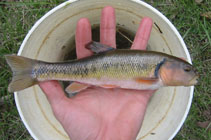
Rückenflossenweichstrahlen (insgesamt) : 8. Semotilus atromaculatus is distinguished by having the following characters: body barely compressed at front, compressed at caudal peduncle; mouth pointed; 47-65 scales on lateral line; dorsal fin with 8 rays; large black spot at front of dorsal fin base, black caudal spot (not distinct in large individuals); large terminal mouth reaching past front of eye. Coloration consists of gray-brown above, dark stripe along back; herringbone lines on upper side in young; dusky black stripe (darkest on young) along olive-silver side, around snout and onto upper lip; black bar along back of gill cover; and orange at dorsal base, orange lower fins, blue on side of head, pink on lower half of head and body, and 6-12 large tubercles on head in breeding males (Ref. 86798).
Adults inhabit rocky and sandy pools of headwaters, creeks and small rivers (Ref. 5723, 86798). Mostly found in tiny, intermittent streams. Young feed on small aquatic invertebrates while adults consume small fish, crayfish and other large invertebrates (Ref. 10294). One of the most common fishes in eastern North America (Ref. 86798).
Male digs a pit in the stream bottom by removing mouthful of gravel, guards the pit and attempts to attract females. Spawning occurs over the pit. Male guards the nest from intruders. As eggs are deposited in the pit, the male covers them with stones and excavates another pit immediately downstream. As spawning continues and the male covers the eggs, a long ridge of gravel develops.
Page, L.M. and B.M. Burr, 2011. A field guide to freshwater fishes of North America north of Mexico. Boston : Houghton Mifflin Harcourt, 663p. (Ref. 86798)
IUCN Rote Liste Status (Ref. 130435: Version 2025-2 (Global))
Bedrohung für Menschen
Harmless
Nutzung durch Menschen
Tools
Zusatzinformationen
Download XML
Internet Quellen
Schätzungen auf der Grundlage von Modellen
Phylogenetischer Diversitätsindex (Ref.
82804): PD
50 = 0.5625 [Uniqueness, from 0.5 = low to 2.0 = high].
Bayesian length-weight: a=0.00617 (0.00251 - 0.01514), b=3.05 (2.83 - 3.27), in cm total length, based on LWR estimates for this (Sub)family-body shape (Ref.
93245).
Trophische Ebene (Ref.
69278): 4.0 ±0.5 se; based on diet studies.
Generation time: 3.9 ( na - na) years. Estimated as median ln(3)/K based on 1
growth studies.
Widerstandsfähigkeit (Ref.
120179): mittel, Verdopplung der Population dauert 1,4 - 4,4 Jahre. (tmax=8; tm=2.5; K=0.41; Fec=2,225).
Anfälligkeit der Fischerei (Ref.
59153): Low to moderate vulnerability (34 of 100).
🛈