>
Cypriniformes (Carps) >
Leuciscidae (Minnows) > Pogonichthyinae
Etymology: balteatus: balteatus meaning girdled (Ref. 1998).
Eponymy: Sir John Richardson (1787–1865) was a Scottish naval surgeon, naturalist and Arctic explorer. [...] (Ref. 128868), visit book page.
More on author: Richardson.
Entorno: milieu / zona climática / rango de profundidad / gama de distribución
Ecología
; agua dulce demersal; potamodromo (Ref. 126106); rango de profundidad 0 - ? m. Temperate; 59°N - 34°N
North America: Pacific Slope drainages from Nass River in British Columbia, Canada to Rogue, Klamath and Columbia River drainages in Oregon, Idaho, Nevada and Wyoming, USA; Bonneville basin in south Idaho, west Wyoming and Utah, USA; Peace River system (Arctic basin) in British Columbia and Alberta, Canada. Introduced into upper Missouri River basin ni Montana and Colorado River drainage in Wyoming, Utah, Colarado and Arizona, USA.
Tamaño / Peso / Edad
Madurez: Lm ? range ? - ? cm
Max length : 18.0 cm TL macho / no sexado; (Ref. 5723); common length : 6.8 cm TL macho / no sexado; (Ref. 12193)
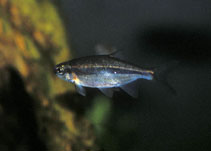
Radios blandos dorsales (total) : 8 - 12; Radios blandos anales: 10 - 24. Body deep and compressed; dorsal fin origin far behind pelvic fin origin; caudal peduncle narrow; caudal fin deeply forked; snout short and point; mouth terminal; eye large; axillary process at pelvic fin base; lateral line decurved, complete wit 52-67 scales; dorsal fin with 8-12 rays (usually 10); anal fin with 10-24 rays (usually 15); intestine long; peritoneum silver; pharyngeal teeth 2,4-4,2 to 2,5-5,2. Olive-gray to brown above, clear to yellow streak above dark stripe along side; red above pectoral fin base on large individuals; clear to yellow-brown fins. Breeding males are brassy yellow, bright red along lower side (Ref. 86798).
Body shape (shape guide): fusiform / normal.
Adults inhabit runs and flowing to standing pools of headwaters, creeks, and small to medium rivers as well as lakes and ponds. Usually found over mud or sand, often near vegetation (Ref. 5723, 86798). They form schools (Ref. 1998). Fry feed on diatoms, copepods, ostracods, and other small planktonic and demersal crustaceans (Ref. 1998). Diet changes to terrestrial and aquatic insects, algae, mollusks, fish eggs (including their own), and small fishes like other redside shiners, other minnows, and trout (Ref. 1998). Preyed upon by mergansers, loons, and mink (Ref. 1998).
Ciclo vital y comportamiento de apareamiento
Madurez | Reproducción | Puesta | Huevos | Fecundidad | Larva
Adults move into spawning streams in the afternoon and evening. Spawning occurs as one female and one or two males thrash violently side by side for a few seconds. Fertilized eggs adhere to gravel and vegetation on the bottom.
Page, L.M. and B.M. Burr, 2011. A field guide to freshwater fishes of North America north of Mexico. Boston : Houghton Mifflin Harcourt, 663p. (Ref. 86798)
Situación en la Lista Roja de la UICN (Ref. 130435: Version 2025-2 (Global))
Amenaza para el ser humano
Harmless
Usos humanos
Herramientas
Informes especiales
Descargar XML
Fuentes de Internet
Estimaciones basadas en modelos
Índice de diversidad filogenética (Referencia
82804): PD
50 = 0.7500 [Uniqueness, from 0.5 = low to 2.0 = high].
Bayesian length-weight: a=0.00871 (0.00401 - 0.01893), b=3.06 (2.88 - 3.24), in cm total length, based on LWR estimates for this (Sub)family-body shape (Ref.
93245).
Nivel trófico (Referencia
69278): 3.4 ±0.49 se; based on food items.
Resiliencia (Referencia
120179): Medio, población duplicada en un tiempo mínimo de 1.4-4.4 años (Preliminary K or Fecundity.).
Vulnerabilidad pesquera (Ref.
59153): Low vulnerability (10 of 100).
🛈