分類 / 名前
共通名の | 類義語 | Catalog of Fishes(部類, 種) | ITIS | CoL | WoRMS | Cloffa
>
Cypriniformes (Carps) >
Leuciscidae (Minnows) > Laviniinae
Etymology: Ptychocheilus: Greek, ptyx, ptychos = fold + Greek, cheilos = lip (Ref. 45335); oregonensis: oregonensis meaning - of Oregon (Ref. 1998).
More on author: Richardson.
環境:環境 / 気候帯 / 深さの範囲 / 分布範囲
生態学
; 新鮮な水 底生の漂泳性; potamodromous (Ref. 126106). Temperate; 55°N - 39°N
North America: Pacific drainages from Nass River in British Columbia, Canada to Columbia River in Nevada, USA; Harney River basin in Oregon, USA; Peace River system (Arctic basin) in British Columbia and Alberta, Canada.
サイズ / 重さ / 年齢
成熟: Lm ? range ? - ? cm
Max length : 63.0 cm TL オス/雌雄の選別がない; (Ref. 5723); common length : 22.0 cm TL オス/雌雄の選別がない; (Ref. 12193); 最大公表体重: 13.0 kg (Ref. 1998); 最大記録サイズ: 11 年 (Ref. 72462)
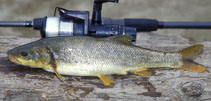
背鰭 (合計) : 9 - 10; 臀鰭: 8 - 9; 脊つい: 44 - 46. Mot deep bodied, greatest depth 16.6% (TL), belly gently rounded in mature individuals. Head moderately long, its length 22.8% (TL); eye small in adults, 17.6% of head length, but larger in young 7.6 cm long, when 25.2% of head length; snout long, 33.1% of head length of adults; interorbital width 29.6% of head length; mouth large, extending back to below anterior margin of eye. All fins clear. Pelvic axillary process usually a ridge. Peritoneum present. Nuptial tubercles fine, on head and back, on pectoral and pelvic fins and sometimes on the caudal fin. Dark green or green-brown dorsally becoming silvery white or cream ventrally. The lower fins of the males become yellow or yellow-orange during spawning period (Ref. 1998). Dorsal fin usually with 9 rays; anal fin with 8 rays; 48-72, usually 51-62, scales on back from head to dorsal fin; 64-79, usually 66-75, scales on lateral line; and 12-20 scales above lateral line (Ref. 86798).
Body shape (shape guide): fusiform / normal.
Found in lakes, pools and occasionally in runs of small to large rivers. Large individuals occur in deep water (Ref. 5723, 86798). They feed on fishes, terrestrial insects, plankton, aquatic insect larvae, and crustaceans while inshore; and on fishes while offshore (Ref. 1998). Male squawfish, prickly sculpins, and newts prey on the eggs (Ref. 1998). Edible but not well appreciated (1998).
ライフサイクルと交尾行動
成熟 | 繁殖 | 放精 | 卵 | 生産力 | 幼生
A female is surrounded by males close to the bottom; eggs and sperm are released at the same time and eggs settle in the gravel.
Page, L.M. and B.M. Burr, 2011. A field guide to freshwater fishes of North America north of Mexico. Boston : Houghton Mifflin Harcourt, 663p. (Ref. 86798)
IUCNのレッドリストの状況は (Ref. 130435: Version 2025-2 (Global))
人間の用途
水産業: 商業; ゲームフィッシュ: はい; 水族館・水槽: 公共の水族館
用具
特記事項
XMLをダウンロードして下さい
インターネットの情報源
モデルに基づく推定値
系統多様性指数 (参照
82804): PD
50 = 0.5625 [Uniqueness, from 0.5 = low to 2.0 = high].
Bayesian length-weight: a=0.01072 (0.00435 - 0.02642), b=3.02 (2.80 - 3.24), in cm total length, based on LWR estimates for this species & (Sub)family-body (Ref.
93245).
栄養段階 (参照
69278): 4.2 ±0.4 se; based on diet studies.
Generation time: 13.6 ( na - na) years. Estimated as median ln(3)/K based on 2
growth studies.
回復力 (参照
120179): 低い, 4.5年~14年の倍増期間の最小個体群 (K=0.08-0.21).
漁業の脆弱性 (Ref.
59153): Moderate to high vulnerability (50 of 100).
🛈