>
Cypriniformes (Carps) >
Leuciscidae (Minnows) > Laviniinae
Etymology: Chrosomus: Chrosomus meaning color (Ref. 1998).
Eponymy: Eos in Greek mythology was the goddess of the dawn. In zoology, her name is generally applied to species that have ‘rosy’ coloration, sometimes combined with orange or yellowish hues that might be reminiscent of a sunrise. (Ref. 128868), visit book page.
More on author: Cope.
Ambiente: milieu / zona climática / intervalo de profundidade / gama de distribuição
Ecologia
; Água doce demersal; não migratória (Ref. 126106). Temperate; 61°N - 41°N
North America: Atlantic, Great Lakes, Hudson Bay, and upper Mississippi, Missouri and Peace-Mackenzie River drainages, from Nova Scotia west to Northwest Territories and British Columbia in Canada; south to northern Pennsylvania, Wisconsin and Nebraska in USA. Isolated population in South Platte River system in Colorado, USA.
Tamanho / Peso / Idade
Maturidade: Lm ? range ? - ? cm
Max length : 8.0 cm TL macho/indeterminado; (Ref. 86798); common length : 4.8 cm TL macho/indeterminado; (Ref. 12193); Idade máx. registada: 3.00 anos (Ref. 12193)
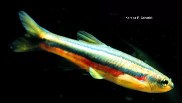
Chrosomus eos is distinguished from a similar species C. erythrogaster by having more rounded, shorter (about equal to eye diameter) snout and more upturned mouth, with chin in front of upper lip. Other characters useful to identify this species include 70-90 lateral scales and red or yellow belly, head, and fins in large males (Ref. 86798).
Adults inhabit lakes, ponds, bogs, and pools of headwaters and creeks. They usually occur over silt, often near vegetation (Ref. 86798). They feed mainly on algae, but also on zooplankton and aquatic insects. Preyed upon by fishes, kingfishers and mergansers (Ref. 1998). Spawning occurs in spring or early summer (Ref. 1998). Used as bait in parts of Ontario and Quebec (Ref. 1998).
Ciclo de vida e comportamento de acasalamento
Maturidade | Reprodução | Desova | Ovos | Fecundidade | Larvas
A female attracts a few males with her darting movements. Together, the group dives into a mass of filamentous algae and release sperm and nonadhesive eggs. The group spawns in several algal masses.
Page, L.M. and B.M. Burr, 2011. A field guide to freshwater fishes of North America north of Mexico. Boston : Houghton Mifflin Harcourt, 663p. (Ref. 86798)
Categoria na Lista Vermelha da IUCN (Ref. 130435: Version 2025-2 (Global))
Ameaça para o homem
Harmless
Utilização humana
Pescarias: espécies comerciais; Aquário: Aquários públicos; isco: occasionally
Ferramentas
Relatórios especiais
Descarregue XML
Fontes da internet
Estimativas baseadas em modelos
Índice de diversidade filogenética (Ref.
82804): PD
50 = 0.5078 [Uniqueness, from 0.5 = low to 2.0 = high].
Bayesian length-weight: a=0.00389 (0.00180 - 0.00842), b=3.12 (2.94 - 3.30), in cm total length, based on all LWR estimates for this body shape (Ref.
93245).
Nível Trófico (Ref.
69278): 2.5 ±0.1 se; based on diet studies.
Generation time: 1.0 ( na - na) years. Estimated as median ln(3)/K based on 1
growth studies.
Resiliência (Ref.
120179): Elevada, tempo mínimo de duplicação da população menor que 15 meses (tmax=3).
Vulnerabilidade da pesca (Ref.
59153): Low vulnerability (12 of 100).
🛈