>
Siluriformes (Catfishes) >
Ictaluridae (North American freshwater catfishes)
Etymology: Ictalurus: Greek, ichtys = fish + Greek, ailouros = cat (Ref. 45335); punctatus: punctatus meaning spotted (Ref. 10294).
More on author: Rafinesque.
Entorno: milieu / zona climática / rango de profundidad / gama de distribución
Ecología
; agua dulce demersal; pH range: 6.0 - 8.0; dH range: 4 - 30; potamodromo (Ref. 126106); rango de profundidad 0 - 15 m (Ref. 9988). Subtropical; 10°C - 32°C (Ref. 12741); 55°N - 25°N, 110°W - 70°W (Ref. 86798)
North America: St. Lawrence-Great Lakes, Hudson Bay (Red River drainage), and Missouri-Mississippi river basins from southern Quebec to southern Manitoba and Montana south to Gulf. Possibly native on Atlantic and Gulf slopes from Susquehanna River to Neuse River, and from Savannah River to Lake Okeechobee, Florida, and west to northern Mexico and eastern New Mexico. Introduced throughout most of US.
Longitud en la primera madurez / Tamaño / Peso / Edad
Madurez: Lm 43.1, range 54 - 67.2 cm
Max length : 132 cm TL macho / no sexado; (Ref. 26550); common length : 57.0 cm SL macho / no sexado; (Ref. 59043); peso máximo publicado: 26.3 kg (Ref. 4699); edad máxima reportada: 24 años (Ref. 59043)
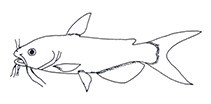
Usually bluish olive, gray or black on the upper part of the body, becoming white below; dark spots usually scattered along the sides; older males dark in color, the head looking very wide when seen from the top; long barbels surrounding the mouth and the tail deeply forked (Ref. 44091).
Body shape (shape guide): fusiform / normal.
Adults inhabit lakes and deep pools and runs over sand or rocks in small to large rivers (Ref. 86798). They occur in rivers and streams and prefer clean, well oxygenated water (Ref. 9988), but also in ponds and reservoirs (Ref. 10294, 44091). Food consists primarily of small fish, crustaceans (e.g. crayfish), clams and snails; also on aquatic insects and small mammals (Ref. 9669, 10294, 44091). Recorded as having been or being farmed in rice fields (Ref. 119549). Marketed fresh, smoked and frozen; eaten steamed, fried, broiled, boiled, microwaved and baked (Ref. 9988). Albino form common in the aquarium trade (Ref. 13371).
Spawning happens, depending on latitude, during the months of April-July, with temperatures between 27-28°C. Females lay their egges on a hole dug on sandy grounds. Incubation lasts 3-8 days, and larval development between 12-16 days, depending on temperature. The pair builds a depression in the ground, which is guarded by the male (Ref. 1672). Channel catfish requires cool water and short day lengths during the winter months for proper egg development; an egg mass can contain up to 20,000 eggs (Ref. 44091). Sexual maturity is reached at 2-3 years.
Page, L.M. and B.M. Burr, 2011. A field guide to freshwater fishes of North America north of Mexico. Boston : Houghton Mifflin Harcourt, 663p. (Ref. 86798)
Situación en la Lista Roja de la UICN (Ref. 130435: Version 2025-2 (Global))
Amenaza para el ser humano
Potential pest (Ref. 13371)
Usos humanos
Pesquerías: muy comercial; Acuicultura: comercial; pesca deportiva: si; Acuario: Comercial
Herramientas
Informes especiales
Descargar XML
Fuentes de Internet
Estimaciones basadas en modelos
Índice de diversidad filogenética (Referencia
82804): PD
50 = 0.5005 [Uniqueness, from 0.5 = low to 2.0 = high].
Bayesian length-weight: a=0.00525 (0.00427 - 0.00645), b=3.13 (3.07 - 3.19), in cm total length, based on LWR estimates for this species (Ref.
93245).
Nivel trófico (Referencia
69278): 4.2 ±0.3 se; based on diet studies.
Resiliencia (Referencia
120179): Bajo, población duplicada en un tiempo mínimo de 4.5-14 años (K=0.06; tmax=16).
Vulnerabilidad pesquera (Ref.
59153): High to very high vulnerability (73 of 100).
🛈
Nutrientes (Ref.
124155): Calcium = 22.8 [11.8, 67.3] mg/100g; Iron = 0.813 [0.451, 1.504] mg/100g; Protein = 16.6 [15.0, 18.5] %; Omega3 = 0.562 [0.205, 1.585] g/100g; Selenium = 37.9 [14.7, 99.1] μg/100g; VitaminA = 22.8 [6.5, 76.8] μg/100g; Zinc = 0.765 [0.504, 1.122] mg/100g (wet weight); based on
nutrient studies.