Ambiente: milieu / zona climatica / distribuzione batimetrica / gamma di distribuzione
Ecologia
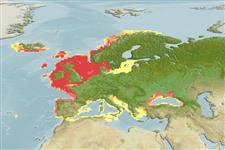
marino; salmastro benthopelagico; oceanodromo (Ref. 51243); distribuzione batimetrica 10 - 200 m (Ref. 1371), usually 30 - 100 m (Ref. 1371). Temperate; 72°N - 35°N, 27°W - 42°E
Northeast Atlantic: southeastern Barents Sea and Iceland to Portugal, also in the Black Sea, Aegean Sea, Adriatic Sea and adjacent areas. Rare in the northwestern Mediterranean.
Lunghezza alla prima maturità / Dimensione / Peso / Età
Maturità: Lm 28.2, range 28 - 30 cm
Max length : 91.5 cm TL maschio/sesso non determinato; (Ref. 106276); common length : 23.5 cm TL maschio/sesso non determinato; (Ref. 1371); peso massimo pubblicato: 3.1 kg (Ref. 40637); Età massima riportata: 20 anni (Ref. 35388)
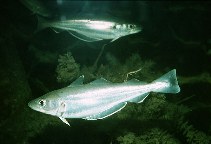
Spine dorsali (totale) : 0; Raggi dorsali molli (totale) : 30 - 40; Raggi anali molli: 30 - 35. Body elongate; head small. Chin barbel small or absent. Lateral-line canals on head with pores. Color is variable; yellowish-brown, dark blue or green, sides yellowish grey, white and silvery on belly; often with a small dark blotch at the upper base of the pectoral fin.
Body shape (shape guide): fusiform / normal; Cross section: circular.
More commonly found from 30 to 100 m, mainly on mud and gravel bottoms, but also on sand and rock. Feed on shrimps, crabs, mollusks, small fish, polychaetes and cephalopods. Migrate to the open sea only after the first year of life. Eggs are pelagic. Larvae and juveniles are associated with jellyfish. Upon maturity, small chin barbel characteristic of juveniles disappear (Ref. 53061). Spawn in batches (Ref. 51846). Utilized fresh, dried or salted, smoked and frozen; eaten steamed, broiled and baked (Ref. 9988).
Oviparous, sexes are separate (Ref. 205).
Cohen, D.M., T. Inada, T. Iwamoto and N. Scialabba, 1990. FAO species catalogue. Vol. 10. Gadiform fishes of the world (Order Gadiformes). An annotated and illustrated catalogue of cods, hakes, grenadiers and other gadiform fishes known to date. FAO Fish. Synop. 125(10). Rome: FAO. 442 p. (Ref. 1371)
Stato della Lista Rossa IUCN (Ref. 130435: Version 2025-2 (Global))
Minaccia per l'uomo
Harmless
Usi umani
Pesca: elevato interesse commerciale; Pesce da pesca sportiva: si; Acquario: Acquari pubblici
Strumenti
Rapporti speciali
Scarica XML
Fonti Internet
Stime basate su modelli
Temperatura preferita (Fonte Biblio.
123201): 7 - 11.9, mean 9.2 °C (based on 409 cells).
Indice di diversità filogenetica (Fonte Biblio.
82804): PD
50 = 1.0000 [Uniqueness, from 0.5 = low to 2.0 = high].
Bayesian length-weight: a=0.00631 (0.00561 - 0.00709), b=3.06 (3.02 - 3.10), in cm total length, based on LWR estimates for this species (Ref.
93245).
Livello trofico (Fonte Biblio.
69278): 4.4 ±0.2 se; based on diet studies.
Generation time: 5.3 (4.4 - 6.8) years. Estimated as median ln(3)/K based on 23
growth studies.
Resilienza (Fonte Biblio.
120179): Medio, tempo minimo di raddoppiamento della popolazione 1.4 - 4.4 anni (rm=1.1-1.6(?); K=0.07-0.74; tm=1-4; tmax=20; Fec>100,000).
Prior r = 0.49, 95% CL = 0.33 - 0.74, Based on 20 full stock assessments.
Vulnerabilità della pesca (Ref.
59153): High to very high vulnerability (67 of 100).
🛈
Vulnerabilità climatica (Ref.
125649): Moderate to high vulnerability (47 of 100).
🛈
Nutrienti (Ref.
124155): Calcium = 18 [9, 36] mg/100g; Iron = 0.2 [0.1, 0.6] mg/100g; Protein = 18 [16, 20] %; Omega3 = 1 [0, 2] g/100g; Selenium = 17.8 [8.2, 36.9] μg/100g; VitaminA = 11.9 [3.0, 48.0] μg/100g; Zinc = 0.242 [0.129, 0.709] mg/100g (wet weight); based on
nutrient studies.