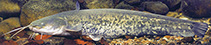
Ambiente: milieu / zona climática / intervalo de profundidade / gama de distribuição
Ecologia
; Água doce; estuarina bentopelágico; não migratória; intervalo de profundidade 0 - 30 m (Ref. 9988). Temperate; 4°C - 20°C (Ref. 2059); 62°N - 36°N, 0°E - 80°E
Europe and Asia. North, Baltic, Black, Caspian and Aral Sea basins, as far north as southern Sweden and Finland; Aegean Sea basin in Maritza and from Struma to Sperchios drainages; Turkey. Absent from the rest of Mediterranean basin. Now widely introduced and translocated throught Europe and Lake Balkhash basin in Kazakhstan. Several countries report adverse ecological impact after introduction.
Comprimento na primeira maturidade / Tamanho / Peso / Idade
Maturidade: Lm 87.5, range 86 - 108 cm
Max length : 273 cm TL macho/indeterminado; (Ref. 123627); peso máx. Publicado: 130.0 kg (Ref. 123627); Idade máx. registada: 80 anos (Ref. 59043)
Descrição breve
Chaves de identificação | Morfologia | Morfometria
Espinhos dorsais (total) : 1; Raios dorsais moles (total) : 4 - 5; Espinhos anais: 1; Raios anais moles: 83 - 95. Distinguished from all other freshwater fishes in Europe by the following unique characters: two pairs of mental barbels; and anal fin with 83-91½ rays. Differs further from the following combination of features: body naked; large, depressed head; dorsal fin with 2-4½ rays; caudal fin rounded or truncate; no adipose fin; and anal rays almost touching caudal (Ref. 59043). Caudal fin with 17 rays (Ref. 2196).
Body shape (shape guide): elongated.
The maximum length of the species has been recorded as 5 m for a long time and the maximum weight as 306 kg . It has been demonstatred that misidentifications and problems of measurment units have led to these numbers. The recorded maxima with evidence are 2.73 m and 130 kg (Ref. 123627). Inhabits large and medium size lowland rivers, backwaters and well vegetated lakes (Ref. 59043). Occurs mainly in large lakes and rivers, though occasionally enters brackish water in the Baltic and Black Seas (Ref. 9988). Found in deep waters of dams constructed on the lower reaches of rivers (Ref. 9696). A nocturnal predator, foraging near bottom and in water column. Larvae and juveniles are benthic, feeding on a wide variety of invertebrates and fish. Adults prey on fish and other aquatic vertebrates. Attains first sexual maturity at 2-3 years of age (Ref. 59043). Spawns in the salt water of the Aral Sea (at Kulandy) (Ref. 1441). Marketed fresh, canned and frozen; can be pan-fried and baked (Ref. 9988). Locally threatened due to river regulation destroying shallow spawning sites (Ref. 59043).
Males defend small territories in the spawning sites and construct nests made of plant materials. They dig shallow depressions or clean spawning substrate such as willow (Salix) and roots. Males guard the nests until larvae emerge. Spawns in pairs. Eggs hatch in 2-3 days. Larvae live in the nest until yolk sac is absorbed for 2-4 (Ref. 59043). Eggs are surrounded by a mucous and adherent wrapping. Incubation lasts about 50 hours at 24°C. Egg size 3 mm, larval length at hatching 8.5 mm (Ref. 26211).
Kottelat, M. and J. Freyhof, 2007. Handbook of European freshwater fishes. Publications Kottelat, Cornol and Freyhof, Berlin. 646 pp. (Ref. 59043)
Categoria na Lista Vermelha da IUCN (Ref. 130435: Version 2025-2 (Global))
Ameaça para o homem
Potential pest
Utilização humana
Pescarias: espécies comerciais; Aquacultura: espécies comerciais; peixe desportivo: sim
Ferramentas
Relatórios especiais
Descarregue XML
Fontes da internet
Estimativas baseadas em modelos
Índice de diversidade filogenética (Ref.
82804): PD
50 = 0.5001 [Uniqueness, from 0.5 = low to 2.0 = high].
Bayesian length-weight: a=0.00631 (0.00528 - 0.00753), b=2.99 (2.94 - 3.04), in cm total length, based on LWR estimates for this species (Ref.
93245).
Nível Trófico (Ref.
69278): 4.4 ±0.2 se; based on diet studies.
Resiliência (Ref.
120179): Baixo, tempo mínimo de duplicação da população 4,5 - 14 anos (tm=3-4; tmax=30).
Vulnerabilidade da pesca (Ref.
59153): Very high vulnerability (84 of 100).
🛈
Nutrientes (Ref.
124155): Calcium = 20.8 [8.1, 39.9] mg/100g; Iron = 0.331 [0.098, 0.866] mg/100g; Protein = 17.1 [15.2, 18.7] %; Omega3 = 0.286 [0.121, 0.672] g/100g; Selenium = 22.5 [10.0, 51.5] μg/100g; VitaminA = 8.18 [2.27, 37.75] μg/100g; Zinc = 0.442 [0.243, 1.135] mg/100g (wet weight); based on
nutrient studies.