Ambiente: milieu / zona climatica / distribuzione batimetrica / gamma di distribuzione
Ecologia
marino; salmastro benthopelagico; distribuzione batimetrica 15 - 136 m (Ref. 36453). Subtropical; - 38°S
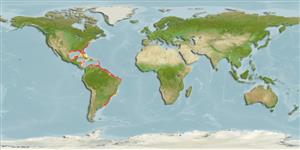
Western Atlantic: northeastern USA to Rio de Janeiro, Brazil, sometimes reaching Argentina.
Lunghezza alla prima maturità / Dimensione / Peso / Età
Maturità: Lm 12.0 range ? - ? cm
Max length : 36.0 cm TL maschio/sesso non determinato; (Ref. 39376); common length : 18.0 cm TL maschio/sesso non determinato; (Ref. 5217)
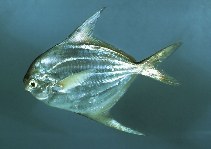
Spine dorsali (totale) : 2 - 5; Raggi dorsali molli (totale) : 38 - 47; Spine anali: 2 - 3; Raggi anali molli: 35 - 45. This species is distinguished by the following characters: body very deep (its depth 1.6 to 1.8 in total length), bounded by even curves and strongly compressed; snout short and blunt, about equal to eye diameter; mouth small, tip of maxillary just reaching to below eye margin; teeth in jaws weak, in 1 row, those in the upper jaw slightly recurved, simple and pointed; dorsal and anal fin bases very long (about equal in length), both fins falcate, the length of their longest rays greater than head and preceded by 3 weak spines; caudal fin stiff and deeply forked, both its lobes longer than head; pectoral fins narrow and much longer than head; pelvic fins absent; no conspicuous series of pores below dorsal fin; lateral line high, following dorsal profile; scales small and easily detached, extending to cheeks and bases of vertical fins; body color pale blue to green above, silvery with a golden/yellow tinge below (Ref. 53006).
Body shape (shape guide): short and / or deep.
A pelagic fish forming large schools in coastal bays, inshore waters over the continental shelf and around islands at moderate depths (50 to 70 m) where it occurs throughout the year (Ref. 53006). Juveniles are found in shallow coastal waters under floating weeds; also in or near brackish estuaries (Ref. 5217). The young of less then 10 cm length are often encountered in association with medusae. Adults feed mainly on jellyfish, small fish, crustaceans and worms while juveniles are plankton feeders. Caught mainly with otter trawls, also seines; marketed fresh and frozen (Ref. 53006). Its flesh is well esteemed.
Ciclo vitale e comportamento di accoppiamento
Maturità | Riproduzione | Deposizione | Uova | Fecondità | Larve
Cervigón, F., 1994. Los peces marinos de Venezuela. Volume 3. Fundación Científica Los Roques, Caracas,Venezuela. 295 p. (Ref. 13628)
Stato della Lista Rossa IUCN (Ref. 130435: Version 2025-2 (Global))
Minaccia per l'uomo
Harmless
Usi umani
Pesca: scarso interesse commerciale
Strumenti
Rapporti speciali
Scarica XML
Fonti Internet
Stime basate su modelli
Temperatura preferita (Fonte Biblio.
123201): 14.8 - 27.4, mean 24.2 °C (based on 268 cells).
Indice di diversità filogenetica (Fonte Biblio.
82804): PD
50 = 0.5020 [Uniqueness, from 0.5 = low to 2.0 = high].
Bayesian length-weight: a=0.01622 (0.01294 - 0.02032), b=2.95 (2.89 - 3.01), in cm total length, based on LWR estimates for this species (Ref.
93245).
Livello trofico (Fonte Biblio.
69278): 4.5 ±0.0 se; based on diet studies.
Resilienza (Fonte Biblio.
120179): Alto, tempo minimo di raddoppiamento della popolazione meno di 15 mesi (Preliminary K or Fecundity.).
Vulnerabilità della pesca (Ref.
59153): Low to moderate vulnerability (26 of 100).
🛈
Nutrienti (Ref.
124155): Calcium = 70.1 [30.9, 192.1] mg/100g; Iron = 0.877 [0.387, 1.939] mg/100g; Protein = 18.1 [16.3, 19.8] %; Omega3 = 0.381 [0.193, 0.755] g/100g; Selenium = 34.6 [13.9, 81.4] μg/100g; VitaminA = 9.82 [2.20, 41.96] μg/100g; Zinc = 0.719 [0.420, 1.210] mg/100g (wet weight);