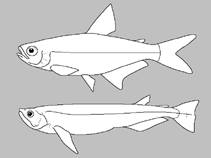
Classificazione / Nomi
Nomi Comuni | Sinonimi | Catalog of Fishes(Genere, Specie) | ITIS | CoL | WoRMS | Cloffa
>
Characiformes (Characins) >
Characidae (Characins; tetras) > Tetragonopterinae
Etymology: Tetragonopterus: Name from Greek words: 'Tetra' meaning four; 'gonia' meaning angle; 'pteron' for fin; referring to the evident tetragonal shape of the body (Ref. 124043); georgiae: Named in honor of the wife of the describer (Ref. 27188).
Eponymy: Georgette Géry was the wife of the author Dr Jacques Géry (1917–2007) (q.v.). Although the original text was silent, the author later revealed that this was the lady honoured. (Also see Georgia) (Ref. 128868), visit book page.
More on author: Géry.
Taxonomic Remarks
See Géry (1977: 446) for identification key.
Ambiente: milieu / zona climatica / distribuzione batimetrica / gamma di distribuzione
Ecologia
; acqua dolce pelagico. Tropical
South America: Sipaliwini, Maroni, Mana, Sinamary, Comté, Approuagua, and Oyapock River basins.
Dimensione / Peso / Età
Maturità: Lm ? range ? - ? cm
Max length : 12.1 cm SL maschio/sesso non determinato; (Ref. 101566)
Breve descrizione
Chiavi di identificazione | Morfologia | Morfometria
Raggi dorsali molli (totale) : 9; Raggi anali molli: 23 - 27; Vertebre: 29. This species is distinguished from its congeners, except T. rarus, by the number of scale rows between lateral line and pelvic fin origin 4.5-5.5 (vs. 3.5 scale rows); differs from T. rarus by the longitudinal dark stripes on the trunk which is absent (vs. present); differs from T. anostomus, T. denticulatus, T. kuluene, T. juruena by the principal teeth in dentary 4 (vs. 5-6) with larger and more robust teeth (vs. thinner and sharper teeth); differs from T. anostomus, T. kuluene by the conspicuous humeral marks 2 (vs. 1 and inconspicuous); differs from T. anostomus by the mouth being terminal (vs. subsuperior); differs from T. anostomus, T. araguaiensis with gill rakers on the lower limb of the first gill arch 10-12 (vs. 17-20) and upper limb 7-8 (vs. 10-12); differs from T. argenteus by the predorsal scales 8 (vs. 11-17), and from T. carvalhoi by having a rounded dark mark on the caudal peduncle (vs. a lozenge-shaped); differs from T. ommatus by teeth on maxilla 1-4 (vs. 7-8) and with a dark mark centered on caudal peduncle (vs. mark limited to the posterior portion of the caudal peduncle) (Ref. 124043).
Cross section: compressed.
Occupies the counter current zones of rivers where it hides under the rocks. It is constantly on the look out for food items that fall into the water (Ref. 12225).
Ciclo vitale e comportamento di accoppiamento
Maturità | Riproduzione | Deposizione | Uova | Fecondità | Larve
Silva, G.S.C., B.F. Melo, C. Oliveira and R.C. Benine, 2016. Revision of the South American genus Tetragonopterus Cuvier, 1816 (Teleostei: Characidae) with description of four new species. Zootaxa 4200(1):1-46. (Ref. 124043)
Stato della Lista Rossa IUCN (Ref. 130435: Version 2025-2 (Global))
Minaccia per l'uomo
Harmless
Usi umani
Strumenti
Rapporti speciali
Scarica XML
Fonti Internet
Stime basate su modelli
Indice di diversità filogenetica (Fonte Biblio.
82804): PD
50 = 0.5000 [Uniqueness, from 0.5 = low to 2.0 = high].
Bayesian length-weight: a=0.02399 (0.01270 - 0.04533), b=2.99 (2.82 - 3.16), in cm total length, based on LWR estimates for this species & Genus-body shape (Ref.
93245).
Livello trofico (Fonte Biblio.
69278): 3.6 ±0.4 se; based on size and trophs of closest relatives
Vulnerabilità della pesca (Ref.
59153): Low vulnerability (10 of 100).
🛈