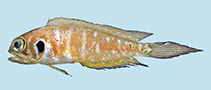
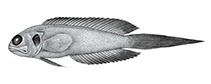
>
Ovalentaria/misc (Various families in series Ovalentaria) >
Opistognathidae (Jawfishes)
Etymology: Lonchopisthus: Greek, logche = lance + Greek, opisthe = behind (Ref. 45335).
Eponymy: James Booth Higman (1922–2009) was an American fisheries biologist. [...] (Ref. 128868), visit book page.
Ambiente: milieu / zona climatica / distribuzione batimetrica / gamma di distribuzione
Ecologia
marino demersale; distribuzione batimetrica ? - 100 m (Ref. 13628), usually 40 - 70 m (Ref. 13628). Tropical
Western Atlantic: Venezuela (including Gulf of Venezuela) and Suriname.
Dimensione / Peso / Età
Maturità: Lm ? range ? - ? cm
Max length : 13.5 cm TL maschio/sesso non determinato; (Ref. 13628)
Spine dorsali (totale) : 11; Raggi dorsali molli (totale) : 17 - 18; Spine anali: 3; Raggi anali molli: 17.
Body shape (shape guide): elongated.
Found on muddy bottoms. Feed on small decapods, shrimps and fishes. Mouthbrooders (Ref. 240).
Ciclo vitale e comportamento di accoppiamento
Maturità | Riproduzione | Deposizione | Uova | Fecondità | Larve
Employ mouthbrooding to care for their young (Ref. 240).
Cervigón, F., 1994. Los peces marinos de Venezuela. Volume 3. Fundación Científica Los Roques, Caracas,Venezuela. 295 p. (Ref. 13628)
Stato della Lista Rossa IUCN (Ref. 130435: Version 2025-2 (Global))
Minaccia per l'uomo
Harmless
Usi umani
Strumenti
Rapporti speciali
Scarica XML
Fonti Internet
Stime basate su modelli
Indice di diversità filogenetica (Fonte Biblio.
82804): PD
50 = 0.5312 [Uniqueness, from 0.5 = low to 2.0 = high].
Bayesian length-weight: a=0.00389 (0.00180 - 0.00842), b=3.12 (2.94 - 3.30), in cm total length, based on all LWR estimates for this body shape (Ref.
93245).
Livello trofico (Fonte Biblio.
69278): 3.9 ±0.63 se; based on food items.
Vulnerabilità della pesca (Ref.
59153): Low vulnerability (10 of 100).
🛈