>
Cypriniformes (Carps) >
Cyprinidae (Minnows or carps) > Torinae
Etymology: Carasobarbus: Latinization of , karass, karausche, European crucian carp + Latin, barbus = barbel (Ref. 45335); exulatus: The specific name is derived from the Latin for banished and refers to the isolation of its habitats (Ref. 113720).
Entorno: milieu / zona climática / rango de profundidad / gama de distribución
Ecología
; agua dulce bentopelágico. Tropical
Asia: Wadi Hadramaut and Wadi Maran, Yemen (Ref. 113720).
Tamaño / Peso / Edad
Madurez: Lm ? range ? - ? cm
Max length : 28.8 cm SL macho / no sexado; (Ref. 94477)
Descripción breve
Claves de identificación | Morfología | Morfometría
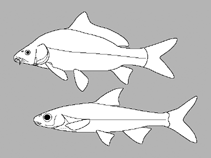
Espinas dorsales (total) : 0; Radios blandos dorsales (total) : 11 - 14; Espinas anales: 0; Radios blandos anales: 8 - 9; Vértebra: 37 - 39. Diagnosis: The mouth of this species has a more ventral position than that of the other Carasobarbus species, being almost inferior (Ref. 57642). It is the only species of the genus Carasobarbus in which both pairs of barbels are always present, the barbels of the anterior pair being often very short, but not quite rudimentary (Ref. 57642). Carasobarbus exulatus differs from all congeners, except C. fritschii and C. harterti in modally having 9 instead of 10 branched dorsal-fin rays; it differs from C. fritschii and C. harterti in modally having 12 scales around the least circumference of the caudal peduncle vs. 16 and in having 24-32 scales on the lateral line vs. 30-39 and 31-38 respectively (Ref. 94477).
Body shape (shape guide): fusiform / normal; Cross section: compressed.
Ciclo vital y comportamiento de apareamiento
Madurez | Reproducción | Puesta | Huevos | Fecundidad | Larva
Banister, K.E. and M.A. Clarke, 1977. The freshwater fishes of the Arabian peninsula. J. Oman Stud. Spec. Rep. 1:111-154. (Ref. 113720)
Situación en la Lista Roja de la UICN (Ref. 130435: Version 2025-2 (Global))
Amenaza para el ser humano
Harmless
Usos humanos
Pesquerías: sin interés
Herramientas
Informes especiales
Descargar XML
Fuentes de Internet
Estimaciones basadas en modelos
Índice de diversidad filogenética (Referencia
82804): PD
50 = 0.5001 [Uniqueness, from 0.5 = low to 2.0 = high].
Bayesian length-weight: a=0.00955 (0.00430 - 0.02123), b=3.02 (2.83 - 3.21), in cm total length, based on LWR estimates for this (Sub)family-body shape (Ref.
93245).
Nivel trófico (Referencia
69278): 3.0 ±0.4 se; based on size and trophs of closest relatives
Resiliencia (Referencia
120179): Medio, población duplicada en un tiempo mínimo de 1.4-4.4 años (Assuming Fec < 10,000).
Vulnerabilidad pesquera (Ref.
59153): Low to moderate vulnerability (25 of 100).
🛈